Is the SAT Optional in 2026? Complete Guide for Applicants
By [Name], US Admissions Consultant | Last updated: April 2026
The short answer: it depends entirely on where you're applying.
For the 2026–2027 application cycle, hundreds of schools remain test-optional — but a growing number of elite universities have reversed course and returned to requiring scores. If you're a student at Sentinel, U Hill, or Magee building your application list right now, this distinction could cost you an acceptance.
Over the years, I've been helping students from BC schools navigate US admissions. The rules around test-optional admissions have never been more confusing, or more consequential, than they are right now.
What "Test-Optional" Actually Means in 2026
Three distinct policy types exist. Confusing them is one of the most common mistakes we see from BC students preparing their US applications.
- Test-optional: You choose whether to submit SAT or ACT scores. Your application is reviewed either way.
- Test-required: Schools won't consider your application complete without standardized test scores.
- Test-free / Test-blind: Schools won't review scores even if you submit them. The UC system is the most prominent example.
Everything here applies equally to the ACT — when schools say "test-optional," they mean both exams.
According to FairTest data (as of spring 2026), more than 2,000 four-year institutions are currently test-optional, with an additional 85 or more operating as test-free. That sounds like standardized testing is becoming irrelevant.
Here's the critical distinction: "Optional" means you control whether your scores are reviewed — not whether they matter. At test-optional schools, students who submit scores are accepted at higher rates than non-submitters, according to institutional data published by multiple test-optional schools. Reports from recent application cycles show score submission rates climbing — a pattern consistent with what admissions offices are reporting publicly.
One student we worked with had a 1460 SAT and strong grades, but didn't submit her score to Northeastern because she assumed "optional" meant it wouldn't help her chances. It cost her an acceptance. Don't make that mistake.
Some schools apply different policies by program, applicant type, or campus. A school that's test-optional for domestic applicants may still expect scores from international students. A school that's test-optional for general admissions may require scores for merit scholarships. Always read the fine print.

Why Elite Universities Are Reversing Course
After the COVID-era expansion of test-optional policies from 2020 to 2023, elite universities started walking those policies back. The pace accelerated sharply through 2024 and 2025.
MIT reinstated its testing requirement in 2022, before most schools had even begun reconsidering. Dartmouth followed in 2024. By 2024, Harvard, Yale, and U Penn had also announced their return to test requirements (effective for the Class of 2029, applying in fall 2024) — meaning these schools have required scores since the 2024–2025 application cycle. If you're applying this fall (for the Class of 2031), scores are required at all of these schools. There's no workaround.
Why Schools Are Reversing Course
Schools cite three main reasons. First, their own research shows SAT and ACT scores accurately predict who will succeed academically, regardless of family income, making scores a reliable signal admissions officers can trust. Second, grade inflation has made GPA a less reliable benchmark. A 4.0 from a school with rampant grade inflation doesn't carry the same weight as a 4.0 from a school with rigorous standards. Admissions offices know this — they just can't say it publicly.
Here's the one that surprised even admissions insiders: test-optional policies may actually hurt lower-income applicants, who had strong scores but assumed those scores wouldn't help them.
The Ivy League trend is real, but it doesn't describe the full picture. Outside the top 30 schools, the majority of universities still maintain test-optional admissions. This is a bifurcating market: some elite schools trending toward test-required, everyone else largely staying put.
As of spring 2026, Brown, Columbia, and Princeton have not reinstated requirements — but their peer institutions' moves create real pressure. The question isn't whether more schools will follow. It's which ones, and when. If you're building your list right now, assume the floor is still moving.
Schools That Now Require Scores: Quick Reference
Here's a quick reference of major universities that have reinstated testing requirements:
| School | New Policy | Effective Year |
|---|---|---|
| MIT | Test-required | 2022 |
| Dartmouth | Test-required | 2024 (Class of 2029) |
| Harvard | Test-required | 2024 (Class of 2029) |
| Yale | Test-required | 2024 (Class of 2029) |
| University of Pennsylvania | Test-required | 2024 (Class of 2029) |
| University of Texas at Austin | Test-required | 2025 (Fall 2025 entry) |
| University of Florida | Test-required | 2023 |
Current as of spring 2026. Verify requirements at each school's official admissions page before submitting — policies announced one year sometimes take effect the next.
Which Colleges Are Still Test-Optional in 2026–2027?
Over 2,000 four-year institutions remain test-optional for the 2026–2027 cycle, including many selective schools and most liberal arts colleges. That said, elite universities are increasingly requiring scores, so your school list matters enormously.
Among highly selective schools, several remain test-optional. NYU, Boston University, Northeastern, and Tulane come up most often from students at York House and Crofton House. Note that Wake Forest reinstated its test requirement for the Class of 2029. Verify each school's current policy directly — these can shift.
In the selective tier, schools like University of Oregon, University of Vermont, George Washington University, and American University have maintained test-optional admissions. Most California State University campuses are test-free by state policy.
Broad-access public universities across the Pacific Northwest, Colorado, Montana, and Michigan are largely test-optional.
Liberal Arts Colleges Still Holding Test-Optional
Liberal arts colleges have made test-optional admissions something of a brand identity. These schools remain committed to the policy heading into the 2026–2027 cycle:
- Bowdoin College — test-optional since 1969, one of the original adopters
- Bates College — test-optional since 1984
- Colby College — test-optional, strong commitment publicly stated
- Hamilton College — test-optional
- Middlebury College — test-optional
- Vassar College — test-optional
- Pitzer College — test-optional
- Hampshire College — test-optional
These schools have invested their admissions philosophy in holistic review. Liberal arts colleges aren't budging.
Public University Systems: State-by-State Snapshot
California: The UC system went test-blind (test-free) permanently in 2021, by state policy. This is the only state with a legislatively imposed ban on testing requirements for public institutions. UC Berkeley, UCLA, UC San Diego — none will review your SAT score even if you send it.
Washington: All four-year public universities in Washington state adopted permanent test-optional policies in 2021. UW Seattle, WSU, Western Washington — all test-optional.
Colorado: Colorado lawmakers gave universities discretion in 2021, and all public four-year institutions declared test-optional at that time. That status has held.
Montana: All state universities in Montana adopted test-optional policies in 2021.
Michigan: Four-year universities in Michigan are test-optional for now — though that "for now" qualifier matters.
Florida: Test-required at the University of Florida. Florida State University is test-optional — verify current policies directly on each school's admissions page.
Texas: Mixed. UT Austin has reinstated its test requirement. Other Texas public schools vary by campus.
New York: SUNY schools vary. NYU (private) remains test-optional.
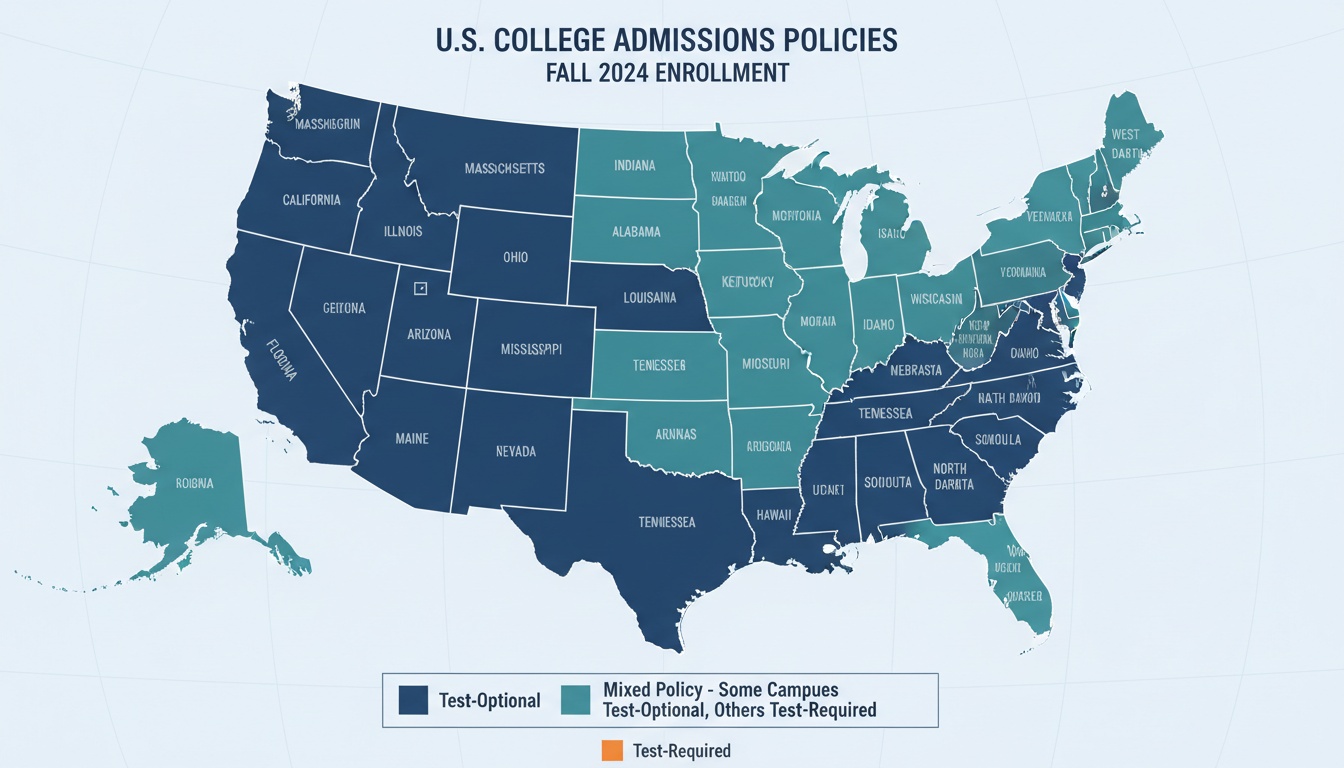
| State | Policy |
|---|---|
| California | Test-blind/test-free (permanent, by state law) |
| Washington | Test-optional (all public 4-year universities) |
| Colorado | Test-optional (all public 4-year universities) |
| Montana | Test-optional (all state universities) |
| Michigan | Test-optional (for now) |
| Florida | Mixed — UF test-required; Florida State test-optional; verify others |
| Texas | Mixed — UT Austin test-required; others vary by campus |
Should You Submit Your SAT Score If It's Optional?
Yes — if your score is at or above the 50th percentile for admitted students at your target school. Submitting a strong score at a test-optional school generally helps; submitting a weak one actively hurts.
Here's the test-optional paradox: at most test-optional schools, students who submit scores are accepted at higher rates than those who don't. That's not a coincidence. Students with strong scores submit them. Students with weak scores don't. This makes non-submission a mild signal in itself, and acceptance rates for non-submitters reflect that reality.
So the real question isn't "is the SAT optional?" It's "does my score help or hurt my college application strategy at this specific school?"
The Score Submission Decision Framework
| Scenario | Action |
|---|---|
| Score at or above 50th percentile | Submit |
| Score below 25th percentile | Don't submit |
| Score between 25th–50th percentile | Depends on overall profile |
Submit your score if:
- Your score is at or above the 50th percentile (median) for admitted students at that school
- You're applying to STEM programs where quantitative ability matters
- You're a first-generation applicant whose GPA context might be unclear to admissions readers
Don't submit your score if:
- Your score falls below the school's 25th percentile for admitted students
- Your GPA, course rigor (AP, IB, DL courses for BC students), and extracurriculars tell a stronger story without it
It depends if:
- You're in the 25th–50th percentile range — here, your specific school list and profile context matter
For international students applying from Canada, it's more complicated. Some schools that are test-optional for domestic US applicants still expect or strongly prefer scores from non-US applicants. Check each school's policy page and look specifically for "international student" language.
To find a school's 25th/75th percentile score ranges, look up their Common Data Set (search "[school name] Common Data Set 2025"). Section C9 shows exactly what standardized test scores admitted students submitted.
Why Test-Optional Policies Can Hurt Lower-Income Students
Dartmouth's 2024 reinstatement announcement cited internal research showing that test-optional policies sometimes disadvantaged lower-income students who had strong scores but assumed those scores wouldn't help. If you're a first-generation college student with a score at or above the 50th percentile at your target school, submit it. Your score provides context that your GPA alone may not.
This is one of the more counterintuitive findings in recent admissions research — and it's worth knowing before you decide to withhold a strong score.
Not sure which of these situations applies to you? Talk to a Vancouver admissions consultant about your specific profile before you decide whether to submit.
How Rare Is a 1350 SAT? Should You Submit It?
A 1350 SAT is strong nationally — at or above the 90th percentile of all test-takers, according to available College Board SAT data. But here's where students get tripped up: college admissions doesn't operate on national percentiles. It operates on each school's admitted student profile.
At schools where the middle 50% range is roughly 1200–1450 — think University of Oregon, University of Vermont — a 1350 is squarely competitive. Submit it.
Note that most CSU campuses are test-free, meaning they don't consider SAT scores at all regardless of what you submit — so the submission question doesn't apply there.
At highly selective schools where the middle 50% range runs 1500–1580, a 1350 falls well below the 25th percentile. Non-submission is the better strategy there. National averages are irrelevant to this decision — always check the specific school's Common Data Set.
College Board's BigFuture tool for filtering colleges by test policy
How Test-Optional Policies Affect Your Chances (Based on Your Background)
The test-optional debate isn't just about strategy. It has real consequences for different student populations — and those consequences help explain why the policy landscape keeps shifting.
Lower-income and first-generation students: As noted above, research suggests test-optional policies can backfire for this group. Students who worked hard to earn strong scores sometimes withheld them under the assumption that "optional" meant scores didn't matter. At schools where submitted scores carry weight, that's a costly misread.
Students with disabilities: Extended-time accommodations on the SAT and ACT are available through College Board and ACT, Inc., but the process requires documentation and advance planning. For students managing learning differences, test-optional policies genuinely reduce pressure — but if your accommodated score is competitive, submitting it still helps.
International and Canadian applicants: Many schools that are test-optional for domestic US students still expect or strongly prefer scores from international applicants, including students applying from BC. The reasoning: admissions offices have less familiarity with non-US grading systems, and standardized test scores provide a common benchmark. Always check the international applicant section of a school's admissions policy separately.
High-achieving students from under-resourced schools: A strong SAT score can signal academic ability that a GPA from an under-resourced school might not fully convey. For these students, submitting a competitive score often strengthens — rather than duplicates — the rest of their application.
The broader point: "test-optional" is not a neutral policy. It affects different students differently, and your individual circumstances should shape your score submission decision.
Which School Types Still Value Test Scores (And Which Ones Don't)
The same label means very different things depending on where you're applying.
| School Type | Test-Optional Status |
|---|---|
| Ivy League & T20 | Mixed — several have returned to test-required, many remain test-optional |
| Public flagships | Highly variable by state |
| Liberal arts colleges | Most remain test-optional or test-free |
Ivy League and elite privates (T20): A growing number have moved to test-required — MIT, Dartmouth, Harvard, Yale, and Penn among them. However, many highly selective schools including Stanford, UChicago, Northwestern, Duke, Johns Hopkins, Vanderbilt, Rice, Notre Dame, WashU, Cornell, Columbia, Brown, and Princeton remain test-optional for the 2026–2027 cycle. Even at test-optional schools in this tier, admitted students submit scores at very high rates — which means non-submitters are competing against a heavily score-submitting pool.
Public flagship universities: Highly variable by state. The UC system is permanently test-blind. UT Austin and UF are test-required. Washington and Colorado are test-optional. There's no unified rule here.
Liberal arts colleges: Most remain test-optional or test-free, and several have made it a genuine differentiator. Bowdoin has been test-optional since 1969. They're not changing.
For students at BC schools like St. George's or West Point Grey Academy who have strong SAT scores, the reversal trend at some elite schools is actually good news. A 1550+ score now carries more weight at schools that require it than it did when everything was optional and standardized test scores were noise.
FairTest's national database of test-optional colleges
What's Next: Predicting Policy Changes for 2027–2028
This is the question every student building a multi-year plan should be asking.
Among highly selective schools, Brown, Columbia, and Princeton have all stated they are remaining test-optional for the 2026–2027 cycle. Their peer institutions' moves do create real pressure, and internal research at peer schools has consistently shown scores add predictive value. Whether any of these three announces a future policy change remains to be seen — watch for announcements in the coming application cycles.
Mid-tier and regional schools are a different story. Test-optional has become a student recruitment tool for these institutions — it expands the applicant pool and signals accessibility. Expect them to hold the policy for the foreseeable future.
Public flagship universities in states without legislative mandates are the wild card. Michigan, Virginia, and North Carolina have all maintained test-optional policies, but none have made permanent commitments. Watch for announcements in fall 2026.
The safest college application strategy: prepare for the test, aim for a competitive score, and treat test-optional as a submission decision rather than a preparation decision.
7 Test-Optional Myths That Could Cost You an Acceptance
Does test-optional mean my SAT score won't hurt me if I submit it?
No. Submit a score below a school's 25th percentile and it works against you. "Optional" means you control whether it's reviewed — not that it's ignored once you send it.
Are test-optional policies permanent?
Definitely not. The 2024–2025 wave of reversals proves these admissions policy changes happen with little warning. Always verify on the school's official admissions page before applying, not on third-party lists that may be months out of date.
Do test-optional policies apply to scholarships too?
Not always. Many merit scholarship programs still require SAT or ACT scores even at test-optional schools. Check scholarship requirements separately — this catches students off guard every application cycle.
Will more schools go back to requiring tests by 2027–2028?
Among highly selective schools, it's possible. Several elite universities have already made the move, and pressure on remaining test-optional schools in this tier is real. Mid-tier and regional schools are expected to maintain test-optional policies, partly because it's become a student recruitment tool.
Does this apply to the ACT too?
Yes. Every policy described here applies equally to the ACT. Test-optional means test-optional for both exams.
I'm applying from BC — does my Canadian transcript change anything?
It can. Some schools that are test-optional for domestic US students still expect scores from Canadian applicants because admissions readers have less familiarity with BC transcripts, IB grading, or DL course designations. Always check the international applicant section of a school's admissions page separately.
What if my score is right on the borderline?
Pull the school's Common Data Set (Section C9) and find where your score falls relative to the 25th and 75th percentile of admitted students. If you're between those numbers, the submission decision depends on how strong the rest of your application is — and that's worth talking through before you hit submit.
Common Data Set Initiative for school-by-school score ranges
Your Test-Optional Action Plan: Decisions to Make Before You Apply
Ready to decide? The test-optional landscape is shifting fast. Your submission decision should be based on your specific school list and profile — not generic advice. Schedule a free US admissions consultation to walk through your schools, your score, and whether test prep makes sense for your timeline.
- More than 2,000 four-year schools remain test-optional, but some elite universities are reversing course
- MIT, Harvard, Yale, Dartmouth, and U Penn have all reinstated testing requirements — if you're applying to any of these schools, scores are required
- California's UC system is permanently test-blind; UF and UT Austin are test-required; Washington, Colorado, and Montana are test-optional statewide
- Submitting a strong score at a test-optional school generally helps — submitting a weak one actively hurts
- A 1350 SAT is strong nationally (at or above the 90th percentile) but falls below the 25th percentile at highly selective schools
- Always check each school's Common Data Set for their admitted student score ranges before deciding whether to submit
- Liberal arts colleges aren't budging
- Lower-income and first-gen students with competitive scores should submit them — research suggests test-optional policies can inadvertently disadvantage this group
- If your score falls between the 25th and 50th percentile at your target school, the submission decision depends on how strong the rest of your application is
- That's not a call to make alone — it's worth talking through before you hit submit
If you're a student at a Vancouver-area school trying to figure out whether to register for the SAT this fall, or whether your current score is worth submitting to your target schools, the answer depends entirely on your specific list. We've helped students from Burnaby North to West Van work through exactly this decision.
Schedule a free US admissions consultation and we'll walk through your school list, your score, and whether test prep makes sense for your timeline.
Planning your US application from BC? These resources will help:
- SAT test centres in BC and registration guide
- Common App deadlines for the 2026–2027 cycle
- Applying to US colleges as a Canadian student
- Best US summer programs to strengthen your application