Yale University Majors: Complete Guide for Canadian Students (2026)
A family in Mississauga earning $190,000 CAD paid less for their daughter's Yale education than they would have for residence and tuition at U of T. That's not a fluke — it's how Yale's need-based aid math works for upper-middle-income Canadian families.
Canadian students access all 80+ Yale College majors as international applicants, with no restrictions on program of study. Here's what that means for your application — and your wallet.

Can Canadians Get Into Yale? Admissions Overview for International Students
Yes. Canadian citizens apply as international students (not domestic), which matters for financial aid calculations but doesn't change which majors they can access or how Yale evaluates their credentials.
Yale's overall acceptance rate has held near 4% for several consecutive admissions cycles. For international applicants specifically, the rate is lower — typically in the 2–3% range, reflecting the depth of the global applicant pool. Canadian applicants compete within that international pool, which is competitive. Treating a Yale application as a long shot is just being realistic. Plan accordingly.
What the Application Requires: Documents and Deadlines
The application goes through the Common App, with Yale-specific supplements. Required materials typically include official transcripts with a school profile, a counselor letter, and two teacher recommendations. Yale has maintained a test-optional policy in recent admissions cycles, so SAT or ACT scores are not required, though submitting a strong score doesn't hurt. Native English speakers from anglophone Canadian schools generally don't need a separate language proficiency test.
One thing that trips up BC families specifically: Yale admissions officers are familiar with the BC Dogwood, the IB Diploma, and AP coursework. You don't need to translate your transcript into American terms — your school counselor's profile letter does that work.
For a closer look at how Yale evaluates BC Dogwood, OSSD, and CEGEP transcripts, see our guide to Canadian transcript evaluation for US admissions.
What Canadian High School Credentials Does Yale Accept?
Ontario's OSSD, BC's Dogwood Diploma, Quebec's DEC and CEGEP, the IB Diploma, and AP coursework are all recognized. No separate English test is required for anglophone Canadian applicants. CEGEP students should apply after completing their first year, which Yale treats as equivalent to Grade 12 standing.
Yale University Majors Available to Canadian Students: Full Breakdown
Yale College offers more than 80 programs of study spanning humanities, STEM, social sciences, and the arts. What makes this genuinely different from UBC or U of T isn't just the number of majors — it's the structure around them.
How Yale's Major System Differs from Canadian Universities
- No distributional core requirements — students design their own path from day one
- Major declaration deadline: end of sophomore year, not first week
- Major courses cover only ~one-third of total coursework, leaving two-thirds for exploration
At McGill, U of T, or UBC, your first year often looks like everyone else's first year in your faculty. At Yale, it doesn't.
Every student starts undeclared. Students have until the end of sophomore year to declare a major, and for most students, courses in their major make up only about one-third of their total 36-course undergraduate program. That's a lot of room to explore Cognitive Science in September and Near Eastern Languages in January without academic penalty.
Unlike some universities where undergraduates compete for limited spots in graduate programs, Yale's graduate schools are entirely separate from Yale College. As an undergrad, you're not navigating prerequisites designed to filter into a graduate pipeline — you're building a degree on your own terms. If you want to accelerate, nearly 20 departments offer a combined bachelor's/master's pathway completable in four years.
Worth knowing early: there is no undergraduate business major at Yale College. Yale School of Management is graduate-only. Canadian students who want a business undergraduate degree should factor this in when comparing Yale to schools like Queen's Commerce or UBC Sauder.
STEM and Pre-Professional Majors at Yale
Yale's most popular STEM programs of study include:
- Applied Mathematics (B.A. or B.S.)
- Computer Science (B.A. or B.S.)
- Computer Science and Economics (B.S.)
- Statistics and Data Science (B.A. or B.S.)
- Biomedical Engineering (B.S.)
- Molecular Biophysics & Biochemistry (B.S.)
- Engineering Sciences — Chemical (B.S.)
Pre-med isn't a major at Yale. Students pursuing medicine typically pair Molecular, Cellular & Developmental Biology or a related science major with the required pre-med coursework. This is the norm at most strong US universities — and it produces better-prepared medical school applicants than a standalone pre-med program would.
There is no undergraduate business major at Yale College. Yale School of Management is graduate-only. Canadian students who want a business undergraduate degree should factor this in when comparing Yale to schools like Queen's Commerce or UBC Sauder.
Humanities and Social Sciences Majors
African Studies (B.A.), American Studies (B.A.), Ethnicity Race & Migration, Global Affairs, History, and Political Science are among the standout humanities and social science programs.
Ethics, Politics & Economics (EP&E) is an interdisciplinary major that draws heavily from Canadian students interested in policy careers. EP&E students take courses like "The Moral Foundations of Politics," "Game Theory," and "International Law." You can't build that program at U of T by cobbling together courses from three different faculties. At Yale, it's a structured, coherent bachelor's degree.
No equivalent program exists at any Canadian university — this is a Yale-specific academic structure.
These interdisciplinary programs are where Yale most clearly separates itself from Canadian alternatives. Major selection is a two-year process of genuine exploration, not a first-week declaration you're locked into.
Financial Aid and Tuition for Canadian Students at Yale
Here's the part that surprises most families. Yale's need-blind admissions policy does not apply to international students, including Canadians. Yale is need-aware for international applicants — meaning financial need can factor into the admission decision. The distinction matters less than it sounds for most applicants. Here's why.
Yale meets 100% of demonstrated financial need for every international student it admits. If Yale admits your child, they will fund the gap between what your family can pay and what Yale costs.
What Does Yale Cost for Canadian Students?
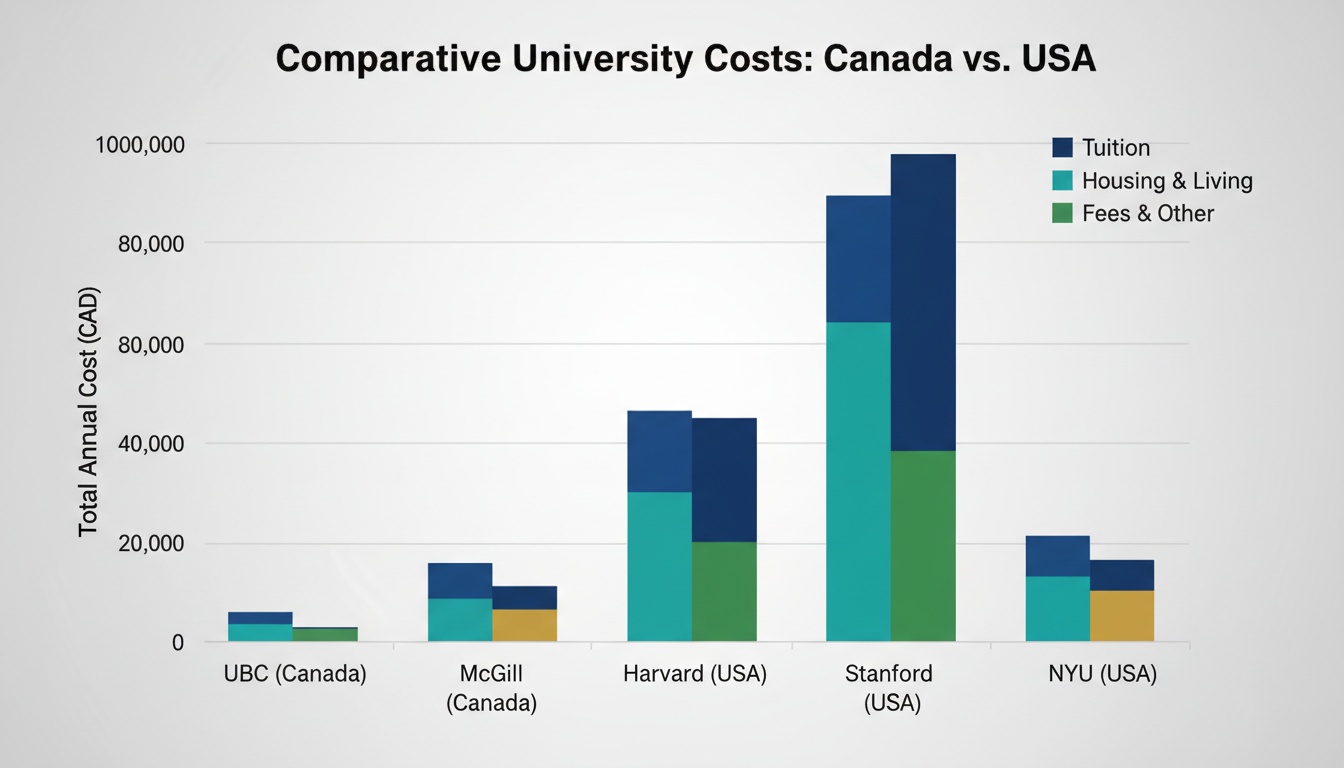
Yale's tuition and fees for the upcoming academic year are published on Yale's financial aid site when available — check directly for the most current figures before planning. Total cost of attendance, including housing and meals, has reached roughly $85,000 USD or more. At an approximate CAD/USD exchange rate of 1.38 (verify the current rate before planning), that translates to approximately $117,000 CAD per year or higher before aid. Check Yale's financial aid site directly for the most current figures before filing your CSS Profile.
Compare that to domestic tuition at U of T or McGill, which has run approximately $10,000–$15,000 CAD per year for Canadian residents in recent years (verify current figures on each university's website). The sticker price gap is real.
| Factor | Yale | U of T | McGill | UBC |
|---|---|---|---|---|
| Annual cost (CAD, sticker) | ~$117K+ | ~$12K | ~$15K | ~$14K |
| Net cost (upper-middle income) | ~$36K | ~$12K | ~$15K | ~$14K |
| Core requirements | None | Yes | Yes | Yes |
| Major declaration | End of Year 2 | Year 1 | Year 1 | Year 1 |
| Post-grad work visa (Canadian) | TN (no cap) | N/A | N/A | N/A |
Sources: Yale financial aid site; university published tuition schedules (approximate, verify current figures directly).
How Much Aid Do Canadian Families Actually Receive?
The contrarian take: for upper-middle-income families who earn too much for Canadian bursaries but not enough to pay $117K CAD out of pocket, Yale's need-based aid can produce a net cost that's surprisingly competitive.
Example: A two-income Ontario household earning $185,000 CAD — above the threshold for most provincial bursaries — received a Yale aid package that set their net cost at approximately $26,000 USD (~$36,000 CAD). That's less than a year of out-of-province residence and tuition at U of T.
How Do Canadians Apply for Yale Financial Aid?
Canadian families file the CSS Profile — not FAFSA (Canadians don't file FAFSA). Yale's net price calculator accepts Canadian income figures. RESP funds are generally counted as assets in financial aid calculations, so talk to a financial advisor before assuming your RESP helps. For a step-by-step walkthrough, see our CSS Profile guide for Canadian students.
Does Yale Offer Merit Scholarships for Canadians?
No. Yale offers only need-based financial aid to all applicants, including Canadians. Merit scholarships are not available at Yale College. External awards like the Loran Scholarship can supplement Yale's aid package, but Yale's own program is purely need-driven.
With the financial picture clear, here's how Canadian students actually use Yale's major flexibility once they arrive.
Popular Majors and Career Outcomes for Canadian Yale Students
Economics, Computer Science, Political Science, Global Affairs, and pre-med tracks are the most common choices among Canadian Yale students. This tracks with where Canadian students tend to go after Yale: law school, medical school, finance, and tech.
A student who arrives intending to study Molecular Biology and ends up in EP&E isn't an edge case — it's a predictable outcome of a system that gives students two years to figure out what they actually want. The structure accommodates that shift without forcing anyone to restart.
Unique programs that aren't replicable at Canadian universities include EP&E, Cognitive Science as a standalone undergraduate major, and Near Eastern Languages & Civilizations. These attract students who already know they want something outside the standard disciplinary categories.
On career outcomes: Yale's undergraduate alumni consistently place at top law schools, medical schools, and technology firms. On Bay Street, a Yale Economics or CS degree competes directly with Queen's Commerce or Western Ivey. In Vancouver's tech sector, Yale CS graduates are recruited by the same companies hiring from UBC and SFU.
After Yale: Visa Options, Work Authorization, and the TN Advantage for Canadian Graduates
Canadian citizens study at Yale on an F-1 student visa for the duration of their degree. After graduation, they qualify for Optional Practical Training (OPT): 12 months of US work authorization. Students who graduate with STEM-designated majors qualify for a 24-month STEM OPT extension, for a total of 36 months of post-graduation work authorization. STEM-designated programs include Computer Science, Applied Mathematics, Statistics and Data Science, Engineering Sciences, and others.
After OPT, the H-1B lottery is the standard path for other international graduates. Canadians face the same cap and the same lottery odds. That's a real risk factor for career planning.
Here's where Canadian citizenship becomes an actual advantage: the TN visa. Under USMCA (formerly NAFTA), Canadian citizens can apply for TN status in qualifying professional roles — engineers, accountants, scientists, management consultants, among others. TN status has no annual cap, no lottery, and can be obtained at the border or a US port of entry. It's dramatically faster and more reliable than H-1B.
TN status requires Canadian citizenship specifically — not just permanent residency. For mixed-status families where a student holds PR but not citizenship, this distinction matters.
For law, Yale doesn't grant an LLB. Canadian students who want to practice law in Canada after a Yale degree will need to go through the NCA (National Committee on Accreditation) process.
TN Visa: The Canadian Advantage After Yale
TN status is available immediately after graduation for qualifying roles. No cap. No lottery. No multi-year wait. (I keep saying this because families consistently underestimate how significant this is — most US-bound Canadian students don't find out about TN until they're already in OPT limbo.)
For a Yale CS or Engineering graduate who wants to work in Seattle or San Francisco before returning to Canada, TN is the practical path that most families don't know about when they're comparing Yale to Canadian universities.
IRCC TN visa eligibility list under USMCA
How to Apply to Yale: Timeline and Checklist for Canadian Applicants
Yale accepts applications through the Common App with Yale-specific supplements. Key deadlines (confirm current cycle dates on Yale's admissions site):
- Restrictive Early Action deadline: November 1
- Regular Decision deadline: January 2
- CSS Profile opens: October 1
- REA is non-binding but restrictive — students can't apply Early Decision or Early Action to other schools simultaneously
Canadian applicants need: official transcripts with a school profile, a counselor letter, two teacher recommendations, and the Yale-specific writing supplements. If submitting test scores under the optional policy, Canadian test centres in Vancouver, Richmond, Burnaby, Toronto, and Montreal all administer the SAT and ACT.
Financial aid forms: Canadian students file the CSS Profile only. FAFSA is for US citizens and eligible non-citizens — Canadians skip it.
After admission, Yale issues an I-20 form. Students use it to apply for their F-1 visa at a US consulate in Canada (Vancouver and Toronto both have consulate offices). Processing times vary, so starting the visa application as soon as the I-20 arrives is the right move.
CEGEP students from Quebec should apply after completing their first year. Applying before that creates transcript gaps that complicate the review.
For a detailed walkthrough of the Yale University admissions process, including supplement strategy and testing timelines, see our full admissions guide. For supplement strategy specific to international applicants, see our Yale supplement guide.
When filling out the Common App activities list, the ordering and framing of extracurriculars matters more than most students realize — especially for international applicants whose activities may look unfamiliar to US admissions readers.
Yale international admissions page
Does Yale Provide Support for International Students After Admission?
Yale's Office of International Students & Scholars (OISS) handles F-1 visa support, OPT applications, and ongoing immigration questions throughout the degree. For Canadian students, the cultural adjustment is minimal. The administrative onboarding — I-20, SEVIS fee, visa appointment — takes real attention in the spring before enrollment.
Yale's residential college system is worth understanding before you arrive. Each college is a self-contained community with its own dining hall, common spaces, and resident faculty — nothing like the anonymous residence towers at most Canadian universities.
One detail that surprises Canadian students used to furnished residence packages: rooms come furnished, but students supply their own toiletries, bedding, and personal items. Toilet paper is not provided; this is standard across US university dorms. Budget roughly $200–$400 CAD for move-in supplies.
One BC student (Computer Science, Class of 2024, from Vancouver) accepted a Seattle tech role on TN status within three weeks of graduation — no H-1B lottery, no wait. Her four-year net cost after financial aid was approximately $98,000 CAD. That's the math that makes Yale worth running the numbers on.
Yale F-1 student resources (OISS)
Key Takeaways
- Canadian students apply to Yale as international students and access all 80+ undergraduate majors at Yale College, with no restrictions on program of study
- Yale's flexible curriculum has no distributional core requirements — students declare their major by the end of sophomore year, and major courses typically cover only one-third of total coursework
- Yale is need-aware (not need-blind) for international applicants, but meets 100% of demonstrated financial need for every admitted student — net cost can be lower than families expect
- There is no undergraduate business major at Yale College; Yale School of Management is graduate-only
- Canadian citizens hold a genuine post-graduation advantage through TN visa eligibility — no cap, no lottery, available immediately for qualifying roles
- CEGEP students should apply after completing their first year; BC Dogwood, Ontario OSSD, IB, and AP credentials are all recognized
- Canadian applicants file the CSS Profile for financial aid — not FAFSA
- Yale's residential colleges provide furnished rooms; students supply their own toiletries and personal items
Ready to build a Yale application strategy that works for your BC or Ontario high school profile? Book a free consultation to talk through your options.