Best US Summer Programs for High School Students 2026: The Complete Matching Guide
Every year, thousands of Canadian high school students apply to US summer programs — and in our experience, most apply to the wrong ones for the wrong reasons. This guide flips that. The best US summer programs for high school depend on your goals: RSI and MITES for STEM research, TASS for humanities, Senate Youth Program for civic leadership, and Johns Hopkins CTY for college-level coursework. Whether you're a grade 10 student at Sentinel or a rising grade 12 at York House, the right program depends entirely on who you are right now and what you actually want to build.
For the 2026 summer cycle, most selective program application deadlines have now passed. Use this guide to plan ahead for the 2027 cycle — and keep reading to understand which programs to prioritize and why.
Are US Summer Programs Worth It for High School Students?
Summer programs are not magic bullets for college admissions. We've seen students attend programs at Ivy-adjacent campuses and write forgettable essays about them. We've also seen students attend a free, low-profile program in rural Vermont and produce the most compelling application narrative of the year.
The real value is harder to measure than a college acceptance.
Spending three to six weeks living with 40 other students who are obsessed with the same things you are changes your intellectual baseline. You stop treating your interests as weird hobbies and start treating them as serious pursuits. That shift shows up in your essays, your interviews, and how you engage in class come September.
Pre-college programs also give first-generation students something money can't easily replicate: exposure to what university life actually feels like, months before applications open.
For students coming from BC schools, there's a geography factor too. Most of your peers are applying to the same UBC, SFU, and US university pools. A summer spent at a residential program in the US gives you campus fluency that differentiates your applications in ways that are hard to fake.
The question isn't whether a summer program is worth it. The question is which one is worth it for you.
How Do You Choose the Right US Summer Program?
Four factors determine fit. Everything else is noise.
1. Academic interest and field. Don't apply to a STEM research program because it sounds impressive if you actually want to study political theory. Admissions readers notice the mismatch.
2. Goal type. Are you trying to produce original research? Earn transferable college credit? Develop leadership skills? Or genuinely explore a field you've never studied formally? Each goal points to a different program category.
3. Budget and financial need. The range is enormous — from fully funded programs with zero cost to pre-college programs running $8,000+ for six weeks. Know your number before you fall in love with a program.
4. Selectivity tolerance and application readiness. Some competitive summer programs accept fewer than 2% of applicants. If your grades took a hit in grade 11, submitting a summer program application to RSI is probably not your best move.
A rough decision guide:
- Original STEM research → RSI, MITES, PRIMES, SSP
- Leadership development → Senate Youth Program, NYLF, HOBY
- Budget is a hard constraint → MITES, RSI, TASS (all free)
- College credit → Johns Hopkins CTY, Brown Pre-College, UW Summer Sessions
- Writing or humanities → Telluride Association Summer Seminar, Kenyon Review Young Writers, Bread Loaf Young Writers
Grade-level eligibility matters more than most families realize. Some programs (like RSI) are exclusively for rising grade 12 students. Others accept rising grade 9s — more on those below. Check summer program eligibility requirements before investing time in an application.
If you're still mapping out which US universities to target alongside these programs, our US college list guide for BC students covers the overlap between program locations and campus visit strategy.
What Summer Programs Accept Grade 9 Students?
Grade 9 students have real options — they're just not the ones that get the most press.
- Johns Hopkins CTY — Grades 7+, with tracks in math, writing, and science; verify current grade 9 offerings directly with CTY
- NYLF — Grades 9+, medicine/law/engineering tracks across multiple cities; verify current eligibility and tracks directly with NYLF
- HOBY — Grade 10 focus (watch for grade 9 eligibility the following year)
If you're in grade 9 at Burnaby North or Magee and wondering whether any of this applies to you: it does. Start with less selective programs that build the specific application skills — personal essays, teacher relationships, activity descriptions — you'll need for the competitive ones in grade 11.
Which Summer Programs Accept Canadian Students?
This doesn't come up enough, and it should. Some programs have citizenship or residency requirements that rule out BC students on study permits — or even permanent residents.
| Program | International Students? |
|---|---|
| US Senate Youth Program | ❌ US citizens only |
| Jack Kent Cooke Foundation Young Scholars | ❌ US-only |
| RSI, MITES, TASS, SSP, Brown Pre-College, Cornell | ✅ Yes |
The Jack Kent Cooke Foundation Young Scholars program also has US-only eligibility. Before investing weeks in a summer program application, verify citizenship requirements on the program's official website.
None of the programs in this guide require a Social Security Number to apply. If you receive a stipend — Clark Scholars has historically offered one — there may be tax implications for non-US students; confirm this directly with the program before accepting.
Beyond citizenship, there's another structural choice that shapes your entire experience: whether to attend in person or virtually.
Virtual vs. In-Person Summer Programs — Which Is Right for You?
Virtual programs are more affordable and accessible; in-person programs offer immersion and peer relationships that virtual formats can't replicate. Choose virtual if cost or family obligations are barriers. Choose in-person if independence and intellectual community are part of your goal.
The term "summer camp" undersells what residential programs actually are — but it's also not wrong. The social texture is real.
Virtual programs have gotten good. More accessible, significantly cheaper, and in some cases drawing a more geographically diverse cohort than their in-person equivalents. But they can't replicate the dorm-room conversation at 11pm — the moment when someone you just met says something that reframes how you think about your entire field. That's the thing residential programs sell. It's worth paying for, if you can.
Top Summer Programs by Category
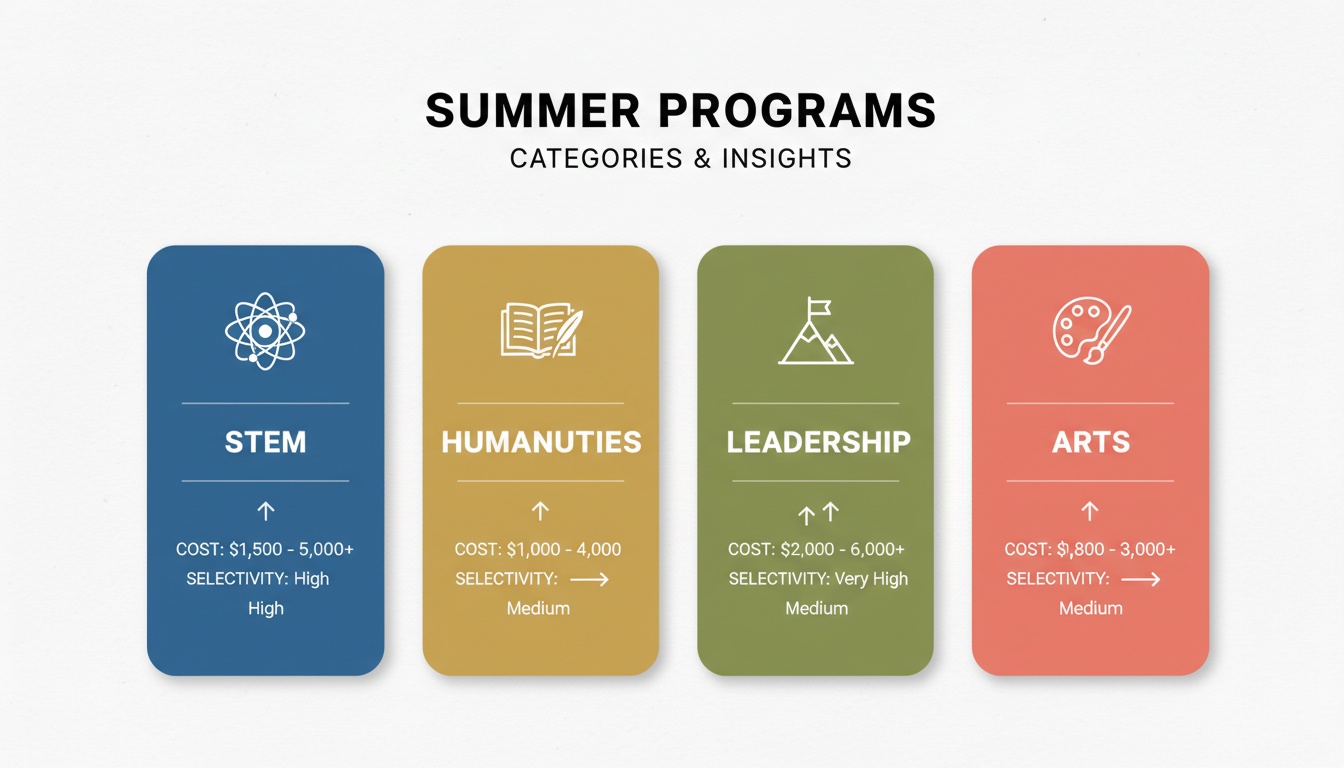
Top programs vary by field. STEM students should consider RSI, MITES, and SSP. Humanities students have Telluride Association Summer Seminar and Kenyon Review Young Writers. Leadership-focused students should look at Senate Youth Program and NYLF. Here's a breakdown by category.
The STEM-heavy bias in most program lists is a real gap. Humanities, arts, and social science students have strong options that most guides ignore.
The Most Selective STEM Research Programs (All Free)
The most selective STEM research programs are RSI (~1-2% acceptance), MITES (~5%), and Clark Scholars (~1%). All are free. RSI and MITES typically open applications in October with January deadlines.
Here's how these programs compare across key factors:
| Program | Cost | Selectivity |
|---|---|---|
| Research Science Institute (RSI) | Free | ~1-2% acceptance |
| MITES (MIT) | Free | ~5% acceptance |
| PRIMES (MIT) | Free | Selective |
| SSP (Summer Science Program) | ~$7,500 (aid available) | ~10% acceptance |
| Clark Scholars (Texas Tech) | Free + stipend | ~1% acceptance |
RSI runs 6 weeks at MIT (Cambridge, MA) with no college credit offered. MITES is also 6 weeks at MIT. PRIMES is a year-long mentorship with a summer component, not a traditional camp format. SSP runs across multiple campuses; verify current duration and locations directly with SSP. Clark Scholars runs in Lubbock, TX; verify current duration directly with the program.
Cost and selectivity figures are estimates based on community-reported data and can vary year to year. Verify current figures directly with each program before applying.
RSI is — and I'm not being hyperbolic here — probably the most selective STEM research program in the country. The 1-2% figure gets thrown around a lot; what it actually means is that most students who apply are exceptional and still don't get in. Students spend six weeks at MIT working on original research with faculty mentors. Applications typically open in October and close in mid-January — earlier than most students expect.
RSI alumni report MIT admission rates well above the general applicant pool — though MIT's admissions office attributes this to the program's selective recruitment, not to any admissions advantage the program confers. RSI didn't create those outcomes; it reflected the students who were already on that trajectory.
MITES is specifically designed to support underrepresented students in STEM, including first-generation and low-income students. It's fully funded. For students from BC's Chinese-Canadian community who are first-generation university applicants, MITES is worth serious attention.
PRIMES is unusual: it's a year-long research mentorship with a summer component, not a traditional camp format. The work is real. So is the time commitment.
Beyond STEM: Humanities Programs That Produce Real Writers and Thinkers
Humanities students should prioritize Telluride Association Summer Seminar (free, highly selective, seminar-based), Kenyon Review Young Writers (intensive writing program), and Bread Loaf Young Writers' Conference (workshop format). These programs emphasize intellectual discussion and writing craft over credentials.
| Program | Cost | Selectivity |
|---|---|---|
| Telluride Association Summer Seminar (TASS) | Free | ~2% acceptance |
| Kenyon Review Young Writers | ~$3,500 (aid available) | Moderate |
| Bread Loaf Young Writers' Conference | ~$1,200 | Moderate |
| National Student Leadership Conference (Humanities) | ~$3,200 | Less selective |
TASS runs 6 weeks at Cornell or Michigan. Kenyon Review runs in Gambier, OH; verify current duration directly with the program. Bread Loaf runs in Ripton, VT; verify current duration directly with the program. NSLC runs across multiple locations; verify current sites, duration, and credit options directly with the program.
Cost figures are estimates and can change annually. Verify directly with each program.
TASS rarely appears on mainstream summer program lists — which is strange given its reported 2% acceptance rate and the alumni outcomes that follow. Students spend six weeks in seminar-style intellectual discussion: no grades, no tests, no lectures. TASS alumni go on to highly selective universities at rates that suggest the program identifies a very particular kind of thinker.
Kenyon Review Young Writers produces students who can actually write. Not "write for a high school contest" write. Actually write. The faculty are working poets and essayists, not writing instructors.
Leadership Programs That Actually Mean Something
"Leadership" gets overused in college applications. These programs define it differently.
| Program | Cost | Selectivity |
|---|---|---|
| US Senate Youth Program | Free (scholarship) | Very selective |
| NYLF (National Youth Leadership Forum) | ~$2,800–$3,600 | Less selective |
| Hugh O'Brian Youth Leadership (HOBY) | ~$300–$500 | Moderate |
Senate Youth Program runs 1 week in Washington, DC. NYLF runs across multiple cities; verify current duration and tracks directly with NYLF. HOBY runs state-based; verify current duration directly with your state program.
Cost figures are estimates and can change annually. Verify directly with each program.
Top leadership programs include the US Senate Youth Program (1 week, free, US citizens only), NYLF (multiple cities), and HOBY (state-based). Each defines leadership differently: Senate focuses on civic engagement, NYLF on professional exploration, HOBY on peer mentorship.
The Senate Youth Program is selective and meaningful — students reportedly meet sitting senators and cabinet members. US citizens only. Many BC students on study permits are ineligible; check before applying.
HOBY is a good entry point for grade 10 students who want leadership development without a highly selective application process.
Earn Real College Credit: Pre-College Programs That Transfer
College credit programs include Johns Hopkins CTY, Brown Pre-College, Cornell Summer College, and UW Summer Sessions. Credit transferability varies by university — don't assume your eventual school will accept it.
| Program | Cost | Selectivity |
|---|---|---|
| Johns Hopkins CTY Summer | ~$5,500–$7,000 | Moderate |
| Brown Pre-College | ~$4,500–$9,000 | Low-moderate |
| Cornell Summer College | ~$6,500–$12,000 | Low-moderate |
| UW Summer Sessions | ~$3,000–$6,000 | Open enrollment |
CTY runs across multiple campuses (and online); verify current locations, duration, and course offerings directly with CTY. Brown Pre-College runs in Providence, RI; verify current duration and credit options directly with Brown. Cornell runs in Ithaca, NY; verify current duration directly with Cornell. UW runs in Seattle, WA. All offer college-level coursework; credit transferability varies by course and receiving institution.
Cost figures are estimates and can change annually. Verify directly with each program.
Credits earned at UW Summer Sessions can transfer to other universities, and students establish a UW transcript in the process, according to UW's official program page. Whether those credits transfer to your eventual university depends entirely on that university's policies. Don't assume.
Brown and Cornell pre-college programs are often misunderstood as admissions pathways to those universities. They're not. More on that below.
What Are the Best Free Summer Programs?
The most selective programs are free: RSI, MITES, TASS, and Clark Scholars offer full funding with no cost to students. Many also cover travel. Need-based aid is available from SSP, Kenyon Review, and Bread Loaf. State university programs like UW Seattle offer affordable open-enrollment options.
The myth that all good programs are expensive is worth dismantling directly.
RSI, MITES, TASS, Clark Scholars — all free. Not discounted. Free, with travel sometimes covered.
Many Coalition member schools offer pre-college summer opportunities with financial aid available, according to the Coalition for College Access. The key is applying early and completing financial aid applications at the same time as program applications, not after.
State university programs often offer the best cost-to-quality ratio. UW Seattle runs open-enrollment summer programs where high school students take real university courses alongside enrolled students. UW's proximity to BC makes it a practical option for students who want to test university life without a cross-continent flight.
California State University summer programs, by contrast, are largely restricted to California residents. State residency requirements vary significantly; always verify before investing time in a summer program application.
Once you've identified programs that fit your goals and budget, the next question is when to apply — and for most competitive programs, the answer is earlier than you think.
Don't Miss the Window: Application Timeline & Deadlines for 2026
Selective summer program applications typically open in September–October and close in November–February. RSI and MITES generally close in mid-January. For the 2026 cycle, most selective program deadlines have already passed. If you're planning ahead for the 2027 cycle, aim to start your applications in the fall — most students who miss out do so because they started in the spring.
Most students start thinking about summer programs in March. Too late for the selective ones.
| Program | Key Dates |
|---|---|
| RSI | Opens Oct 2025 / Due mid-Jan 2026 / Decisions Mar 2026 |
| MITES | Opens Oct 2025 / Due Jan 2026 / Decisions Mar 2026 |
| TASS | Opens Oct 2025 / Due Nov 2025 / Decisions Feb 2026 |
| Clark Scholars | Opens Nov 2025 / Due Feb 2026 / Decisions Mar 2026 |
| SSP | Opens Sep 2025 / Due Feb 2026 / Decisions Mar 2026 |
| Brown Pre-College | Opens Nov 2025 / Deadline spring 2026 / Rolling decisions |
| Cornell Summer College | Opens Nov 2025 / Deadline spring 2026 / Rolling decisions |
| Johns Hopkins CTY | Opens Oct 2025 / Deadline spring 2026 / Rolling decisions |
Dates reflect the 2025–2026 application cycle, now closed. For the 2026–2027 cycle, verify updated dates directly with each program.
If you're a current grade 11 student, use this summer to prepare: identify your target programs, build your activity list, and line up teacher recommenders so you're ready when applications open in the fall for the 2027 cycle.
A complete summer program application typically requires a personal essay (sometimes two), official transcripts, one to two teacher recommendation letters, and occasionally standardized test scores — which means you should request your teacher recommendations at least six weeks before the deadline. Some of the best teacher recommenders are also the busiest. Plan your recommendation letter strategy early.
Apply to programs across selectivity levels. Two reach programs, two match programs. Don't put all your effort into RSI and leave yourself with nothing if it doesn't work out.
Funding Your Summer Program: Scholarships & Financial Aid
Three funding tiers exist: fully funded programs (RSI, MITES, TASS, Clark Scholars), need-based aid from programs themselves (SSP, Kenyon, Bread Loaf), and external scholarships (community foundations, school district funds). Apply for aid simultaneously with program applications, not after.
Tier 1 — Fully funded programs. RSI, MITES, TASS, and Clark Scholars cost nothing. Some cover travel. These programs actively recruit students from low-income backgrounds and first-generation families.
Tier 2 — Need-based aid from the program itself. SSP, Kenyon Review Young Writers, and Bread Loaf all offer need-based grants. Apply for aid at the same time you submit your program application.
Tier 3 — External summer program financial aid. A few options worth knowing:
- Local community foundations (many in Metro Vancouver offer education grants)
- School district enrichment funds (some BC districts have discretionary funds for this)
- BC Ministry of Education international education bursaries
Note: Jack Kent Cooke Foundation Young Scholars has US-only eligibility — not an option for most BC students.
For first-generation families: the financial aid application process for summer programs mirrors the university aid process. You'll typically need tax documents, proof of income, and a brief financial statement. Start collecting those documents in October.
For BC students navigating both summer program costs and university application fees simultaneously, our CSS Profile and FAFSA guide for Canadian students covers the document overlap.
Do Summer Programs Help With College Admissions?
No. Attending a pre-college program at a university does not improve your admissions odds at that university. Harvard's admissions office has stated publicly that pre-college program attendance is not considered in admissions decisions. The pre-college office and the admissions office are separate operations.
Pre-college programs at brand-name universities are revenue-generating operations. They're open to most applicants who can pay. Admissions offices at those same universities explicitly note that pre-college attendance carries no weight in the process.
What matters is what you did there.
A student who attended Brown Pre-College and wrote a vague essay about "expanding my horizons" gains nothing. A student who attended the same program, connected with a professor whose research shaped their senior thesis topic, and wrote about that turning point with specificity — that student gains something real.
The admissions value of summer programs lives in your essays, your activity list, and the recommendation letters your mentors write. Summer program supervisors and research mentors can write exceptionally strong recommendation letters because they've seen you work in a context most high school teachers haven't. Align your summer program plans with your overall application calendar to make sure you have time to cultivate those relationships properly.
We've worked with students from Richmond and Coquitlam who attended free, low-profile summer programs and wrote essays that demonstrated intellectual honesty and specificity that stood out in their cohort. Admissions readers noticed.
One student we worked with — from Burnaby North, grade 12, applying to US schools — attended TASS on a full scholarship. Six weeks later she came back with a completely transformed sense of what she wanted to study. Her application essays practically wrote themselves. She had something real to say. Three top-20 US university acceptances.
Choose programs for growth. The admissions benefit follows from that, not the other way around.
How Do You Write About Your Summer Program in College Essays?
Write about the specific moment, not the program itself. Describe the paper that broke your assumptions, the argument you lost, or the research result that surprised you. Use your activity list to name the specific research or skill. Ask your mentor for a recommendation letter.
This is where most students leave value on the table. They attend a strong program, have a genuine experience, and then write a generic essay about it.
- Write about the moment, not the program. Write about the specific moment. The paper you read that broke your prior assumptions. The argument you lost and what it cost you intellectually. The research result that didn't match your hypothesis — and what you did next.
- Use your 150 characters precisely. "Conducted original astrophysics research at MIT under faculty mentorship; presented findings to cohort of 80 students" beats "Attended summer research program at MIT" by a wide margin.
- Ask your mentor for a recommendation letter. They've seen you work independently in a university environment — that's a context your BC teachers haven't observed. The letter will be different in kind, not just degree.
Specificity is the difference between an essay that reads like a brochure and one that reads like a person.
What You Need to Know Before You Apply: Key Takeaways
- The most selective STEM research programs (RSI, MITES, Clark Scholars) are completely free — cost is not a barrier to the best programs. Read that again.
- Humanities and arts students have strong options (TASS, Kenyon Review, Bread Loaf) that most lists ignore
- Not sure which programs match your profile? We help BC students build a summer program shortlist based on goals, budget, and timeline.
- Summer program applications for selective programs are due November through January — start in the fall, not the spring
- Attending a pre-college program at a brand-name university does not improve your admissions odds at that university. This surprises families every time we say it.
- The admissions value of any summer program lives in your essays and recommendations, not the program's name
- Check citizenship and residency requirements before applying — some programs are US-only
- Match the program to your actual goals: research, credit, leadership, exploration, or writing
Most students who get the most out of these programs aren't the ones who chose the most prestigious name on the list. They're the ones who chose the right fit — and then did something real with it.
Ready to figure out which summer program fits your specific profile, goals, and budget? Book a free consultation with a Vancouver-based advisor — we'll build a shortlist across selectivity levels and identify programs that align with your actual interests, not just your resume.