SAT Retake Strategy: A Data-Driven Guide (2026)
We've seen students retake the SAT four times and land within 10 points of their original score every time — not because they didn't work hard, but because they studied the same things the same way. The ones who improve (sometimes by 150 points) treat the retake as a completely different preparation project. Here's the framework we use with students across Vancouver and the Lower Mainland, and why it works.
Should You Retake the SAT? A Data-Driven Decision Framework
The retake decision comes down to three numbers: your current score, your target score, and the gap between them. According to College Board's 2023 SAT Program Results report, 69% of students who took the SAT more than once improved their total score. But "improve" can mean 10 points or 200 points, and those outcomes require very different decisions.
The Cost-Benefit Calculation
The retake fee runs about $60 USD (as of 2026; check College Board for current pricing). Add prep costs — Khan Academy is free, a structured tutoring program varies widely by provider and intensity — and you're looking at a real investment. To put it concretely: a prep investment that moves a student from 1320 to 1430 can be the difference between a merit scholarship and none at a mid-tier US university. The ROI math usually works. The question is whether the score gap is large enough to make that investment rational.
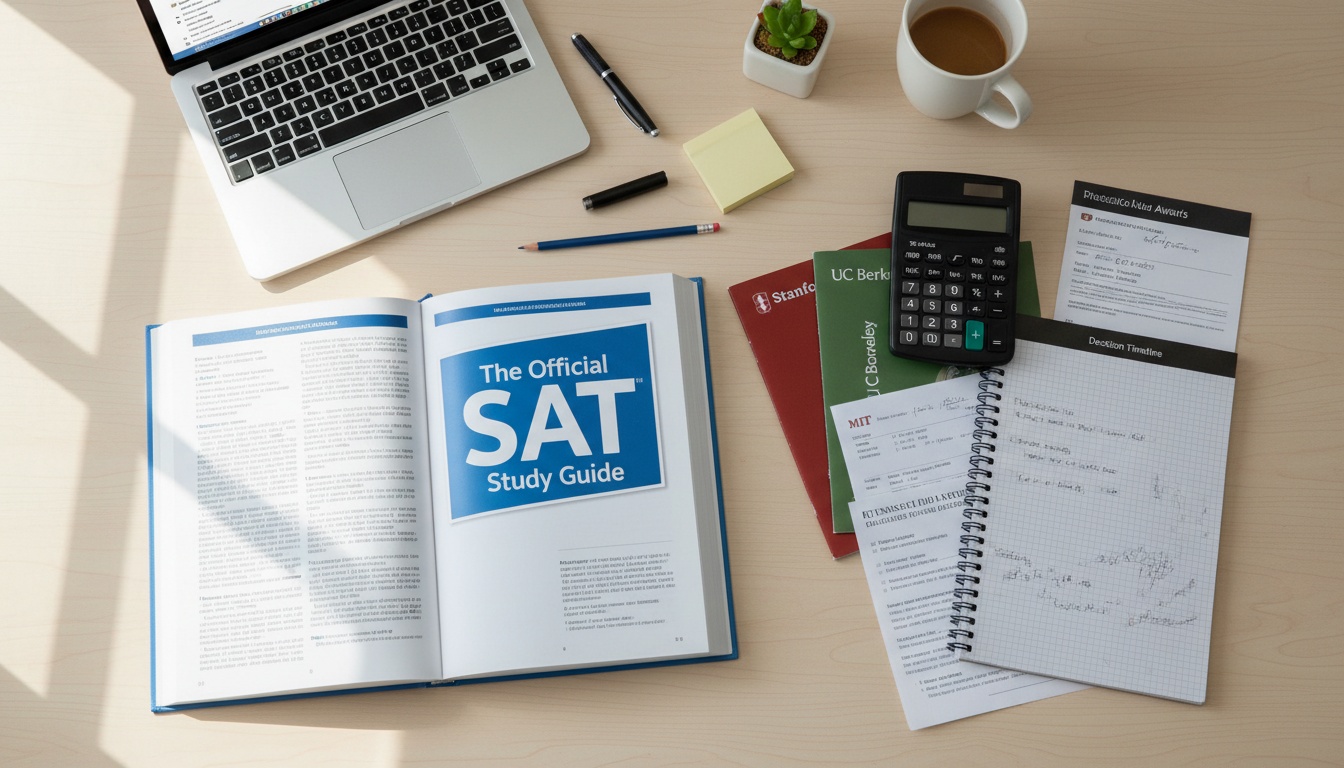
The Retake Decision Matrix:
| Score Gap | Time Available | Recommendation |
|---|---|---|
| Large (100+) | Ample (8+ weeks) | Retake: High Priority |
| Large (100+) | Limited (<6 weeks) | Delay retake date; prep first |
| Small (<50) | Ample | Consider superscore strategy |
| Small (<50) | Limited | Evaluate other application strengths |
On mobile, swipe right to view the full table.
Superscoring changes the calculus here. Most top US universities superscore — meaning they take your highest Math and highest Reading & Writing scores across all sittings. Check each school's current policy to confirm, as superscore practices vary by institution. Even a 30-point bump in one section can shift scholarship eligibility or move you into a stronger applicant pool.
Score choice adds another layer. Many colleges let you choose which scores to send; some competitive schools require all scores. Check each school's policy before you register.
In our experience, we see diminishing returns after a third attempt unless the student takes a genuinely different approach to preparation. If you've already retaken twice with minimal movement, more retakes probably won't move the needle without rethinking the whole prep strategy.
Analyze Your Previous Performance: Find the 3–5 Questions Costing You the Most Points
The most common reason scores plateau on a retake isn't effort — it's studying the wrong things. Categorize every missed question from your previous test into three types: concept gaps, careless errors, and time traps. Then you'll know exactly where to spend your prep time.
We had a student (call her M., Grade 12 at a West Vancouver school, starting score 1310) who spent six weeks drilling algebra before her retake. Her Math score went up 20 points. Her Reading & Writing dropped 30. She'd been ignoring it entirely. A proper performance analysis would have caught that in week one.
A different student — starting at 1390, targeting 1480 — spent his entire first retake prep on Math. His Math went up 10 points. His Reading & Writing, untouched, dropped 20. The diagnostic would have shown him that Reading & Writing was the lever.
How to Analyze Your Score Report
Your score report is where the real work begins. The College Board offers two post-test services. The Question-and-Answer Service gives you the actual test booklet with your answers. The Student Answer Service provides your answer record plus the difficulty level and question type for each item. Request whichever is available for your test date — both give you raw material for a proper performance analysis.
Don't just look at Math vs. Reading & Writing totals. That's the surface level. Go deeper.
The 3-Category Diagnostic Framework:
Category 1 — Concept Gaps: Questions you got wrong because you genuinely didn't know the content. You'd get these wrong again tomorrow.
Category 2 — Careless Errors: Questions you knew how to solve but got wrong anyway — misread the question, arithmetic slip, chose the trap answer. These are recoverable fast.
Category 3 — Time Traps: Questions left blank or rushed in the final minutes. A pacing problem, not a knowledge problem.
Log every missed question in a spreadsheet: question type, skill tag (e.g., Command of Evidence, Linear Functions, Rhetorical Synthesis), error category, and estimated time spent. Once you've logged 30–40 questions, patterns emerge that you cannot see any other way.
This is why a section-based retake mindset — treating Math and Reading & Writing as separate improvement projects — is more effective than trying to lift your composite score as a single target. The score gap in each section tells you where to spend your time.
For a step-by-step walkthrough of how the adaptive modules affect your score trajectory, see our complete Digital SAT beginner's guide.
Reading Your Digital SAT Score Report Differently
Your Module 2 difficulty level reveals your score ceiling. If you landed in hard Module 2 but scored in the 1300s, accuracy under pressure is the problem — not knowledge. If you landed in easy Module 2, improving Module 1 performance is the priority, because stronger Module 1 performance earns you access to the harder Module 2 and its higher score ceiling. Keep in mind that your final score depends on performance across both modules — earning hard Module 2 opens the ceiling, but you still need to perform well in it to reach your target score.
The counterintuitive math: a hard Module 2 with 70% accuracy yields a higher score than an easy Module 2 with 90% accuracy. The score ceiling is simply higher in the harder module. So for retakers, the strategic goal isn't just "get more questions right" — it's "earn the hard module, then perform in it."
Small improvements in Module 1 can unlock a noticeably higher overall score. That's where to focus first.
Set a Smart Target Score Based on Your Starting Point
Realistic goals matter. Chasing a 1600 from a 1280 in eight weeks isn't a strategy — it's a wish.
Here are honest SAT score improvement benchmarks by starting range. These reflect what we typically see with structured preparation, and your results will depend on how consistently you address your specific score gap:
- 1000–1150 starting score: Meaningful gains are possible with consistent prep — expect to close a significant portion of the gap over 10+ weeks
- 1200–1350 starting score: Structured prep targeting concept gaps and careless errors typically produces the strongest results in this range
- 1400–1500 starting score: Diminishing returns kick in; gains require precision work on specific question types, not volume
- 1500+ starting score: Every point requires highly targeted effort; self-diagnosis becomes unreliable at this level
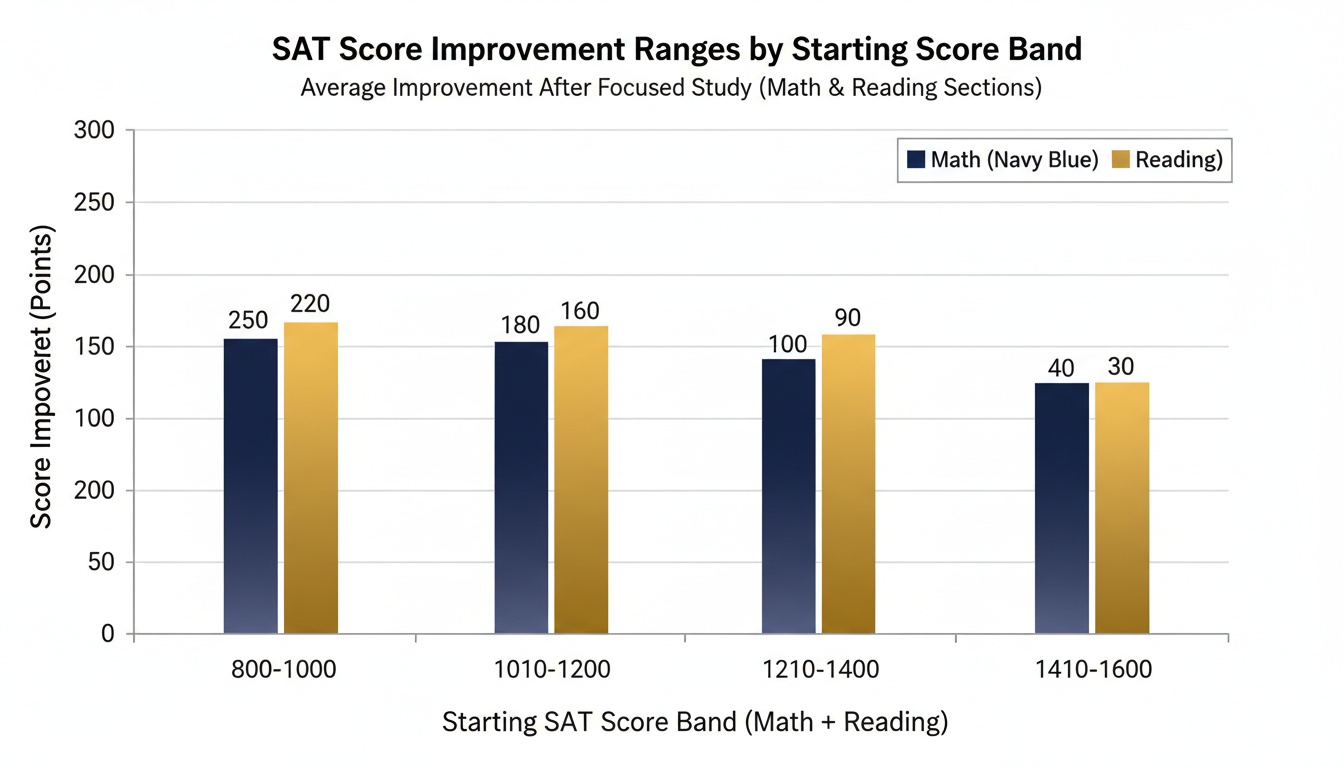
To set your actual target score, look up the 75th percentile SAT score at each school on your college list. Add 20 points as a buffer. That's your number.
Math tends to respond faster to targeted prep than Reading & Writing. Math is largely rule-based — once you understand why a quadratic behaves a certain way, that knowledge sticks. Reading & Writing improvement is slower because it requires building pattern recognition across hundreds of passages. Plan for that difference when you set your study timeline.
Larger score gaps need longer prep windows. A student at 1250 targeting 1400 needs a different timeline than a student at 1450 targeting 1520. The second student needs less volume and more precision — a genuinely different kind of work.
Your Personalized 8–12 Week Retake Study Plan: From 1200 to 1500+ (By Score Range)
What's the best way to prepare for an SAT retake? Use Khan Academy for concept gaps, Bluebook for full-length simulation, and a tutor or AI-adaptive platform for precision work above 1400. Focus the first half of your plan on closing concept gaps, and the second half on test-simulation and time management under realistic conditions.
8-Week Plan: Scores 1200–1350 (Closing the Gap)
At a glance: Week 1–2: Diagnostic | Weeks 3–5: Concept review | Weeks 6–7: Timed practice | Week 8: Test simulation
Weeks 1–2: Run the full diagnostic. No timed practice yet. Categorize every error from your previous test. Identify your top three concept gaps by question type.
Weeks 3–5: Targeted concept review only. Khan Academy's skill-based modules work well here because they adapt to your error patterns in real time, which means you spend study time on the exact concepts holding you back — not generic review. End Week 5 with one full-length mock test under real conditions — timer running, phone away.
Weeks 6–7: Shift to mixed timed practice. Review your error log every single day. Take one full-length mock test per week. The goal is building stamina and identifying which careless errors persist under pressure.
Week 8: Light review only. Test-day simulation (wake up at the same time, same breakfast, same warm-up). No new material.
For students juggling school, sports, and extracurriculars, see our week-by-week two-month SAT plan for a more granular daily breakdown. If your schedule is genuinely unpredictable, check out flexible prep options for students with limited time.
10–12 Week Plan: Scores 1350–1500 (Fine-Tuning for Top Schools)
Weeks 1–2: Deep diagnostic. You're not looking for broad weak areas — you're hunting the 3–5 specific question types costing you the most points. At this score range, the losses are concentrated.
Weeks 3–6: Targeted drill sessions, 30–45 minutes daily, on those specific question types only. Take one full-length mock test every two weeks. Don't over-test at this stage — quality of review matters more than volume.
Weeks 7–10: Full-length timed practice tests weekly. Strict post-test analysis after each one. Do it every week without exception.
Weeks 11–12: Strategy refinement and pacing drills. Mental preparation. No surprises on test day.
Self-study works well for disciplined students with large score gaps. In our experience, students above 1450 almost always benefit from a second set of eyes — not because the content is harder, but because the errors are subtle enough that self-diagnosis misses them.
A Note on Prep Tools for Retakers
Use Khan Academy for concept gaps (free, adaptive), Bluebook for full-length simulation (official tests), and a tutor or AI-adaptive platform for precision work above 1400.
Khan Academy remains the best free option. Because it pulls from actual SAT test data, you're practicing with the same question types and difficulty patterns you'll see on test day — and the adaptive modules mean you spend time on the exact concepts holding you back, not generic review. For full-length simulation, Bluebook's official practice tests are the standard; use them for timed mock tests, not casual review.
If you're in the 1350–1500 range and want more precision, AI-adaptive drilling platforms can catch error patterns you'd miss on your own — like consistently misreading time-pressure questions or making specific algebra mistakes — which means you fix the root cause, not just the symptom. These tools adjust question difficulty in real time based on your responses. That makes them particularly useful when your score gap is concentrated in a narrow set of question types, not spread across an entire section.
Our general rule: Khan Academy for concept gaps, Bluebook for simulation, a tutor or adaptive platform for precision work above 1400. The retake date you choose should determine how aggressively you sequence these tools.
High-Impact Tactics for the Digital SAT's Adaptive Modules (Earn Hard Module 2, Then Perform in It)
Here's where the digital format changes everything for retakers. The paper SAT used a fixed format — though multiple test forms existed per sitting, every student faced the same non-adaptive structure. The digital SAT is fundamentally different — and most retakers never fully adjust their strategy to account for it.
The mechanism is simple: Module 1 performance routes you to either an easier or harder Module 2. Hard Module 2 gives you access to a higher score ceiling. That's the mechanic. A section-based retake approach — treating each module as its own performance analysis target — is the most effective way to put this into practice.
Math Retake Tactics
Topics such as linear equations, systems of equations, quadratics, and data analysis appear regularly across test forms and are worth prioritizing in your prep — though the exact weighting varies by test form. The built-in Desmos calculator is powerful — most retakers underuse it, especially for graphing problems. (Seriously — we've watched students spend 90 seconds on a parabola problem by hand when Desmos would've shown the answer in 8 seconds.)
On pacing: answer easy and medium questions first, flag anything that's going to take more than two minutes, and return with remaining time. Missing two or three hard questions in Module 2 is far less damaging than missing two or three medium questions in Module 1.
Reading & Writing Retake Tactics
The Digital SAT Reading & Writing section tests four main domains: Craft and Structure, Information and Ideas, Standard English Conventions, and Expression of Ideas. Within these, skills involving evidence-based reasoning and synthesis of information are important areas to drill specifically, not just "reading comprehension" generally. For Craft & Structure questions, practice identifying author's purpose quickly and efficiently. Vocabulary-in-context questions often reward attention to nuance — studying word pairs (think "ambiguous" vs. "ambivalent," "reticent" vs. "reluctant") can be more useful than memorizing raw word lists.
Time Allocation Benchmarks
Roughly 1 minute 10 seconds per Reading & Writing question, 1 minute 35 seconds per Math question. Use the flagging tool liberally — it exists for a reason.
Timeline, Logistics, and Mental Preparation: Avoid These 3 Retake Scheduling Mistakes
Retake timing depends on your application deadline. Early Decision/Early Action applicants typically need October sittings to meet November deadlines — check each school's specific cutoff, as these vary by institution and year. Regular Decision applicants can often test in November or December. Schedule your retake 2–3 months after your previous attempt — enough time to address weak areas without losing test-taking momentum.
For Early Decision / Early Action applicants: retake no later than the October sitting in most cases. Confirm score submission deadlines directly with each school, as ED/EA cutoffs vary by institution and are not uniform across colleges.
For Regular Decision applicants: the November or December sitting is viable for many schools. Allow sufficient time between your retake date and the score submission deadline — check each school's requirements, as processing timelines vary. The digital SAT delivers results faster than the paper test, but admissions offices still need time on their end.
College Board's test dates typically run through December each year. Check the official calendar early — registration windows fill faster than most students expect, especially for October sittings in Metro Vancouver.
Generally speaking, too little time between attempts may not leave enough room to genuinely address weak areas, while too long a gap can cause you to lose test-taking momentum. Most students find a window of roughly two to three months works well, though individual circumstances vary.
Mental Preparation — The Part Most Guides Skip
Reframe anxiety as "performance readiness" rather than threat — research shows this improves performance under pressure. Prioritize adequate sleep in the days before the test. Avoid new material in the final days before test day. On test day, don't review answers during breaks — focus on the next module.
Test anxiety before a retake is different from first-time anxiety. There's a specific pressure that comes from knowing what the experience feels like and worrying you'll repeat the same mistakes.
Research on arousal reappraisal backs this up. Telling yourself "I'm excited" rather than "I'm nervous" isn't just positive thinking — it's a cognitive reframe with research support behind it.
Many high scorers took the SAT more than once. Retaking isn't a signal that something went wrong.
Sleep matters more than most students give it credit for. Research consistently links adequate sleep to improved cognitive performance; aim for 7–8 hours in the nights leading up to the test. Avoid new study material in the final days before test day — your brain needs consolidation time, not more input.
On test day: bring snacks, arrive 20 minutes early, and use break time to reset. Don't review your answers during the break. What's done is done — the next module is what matters.
Key Takeaways
- Same approach = same score. Diagnostic-first prep is the only reliable way to move the needle.
- Superscoring makes retakes lower-risk — check each school's policy before registering.
- Your Module 1 performance determines your score ceiling. Earning hard Module 2 is the strategic priority — but you need to perform well in both modules to reach your target score.
- Score improvement is range-dependent. Students at 1200–1350 gain most from concept work; above 1450, it's precision, not volume.
- Mental prep isn't optional. It's half the job.
- Work backward from your deadlines — ED applicants typically need October; RD applicants often have until November or December, depending on the school.
Ready to build your personalized SAT retake strategy? Book a free consultation with our Vancouver team — we'll review your score report, identify your highest-leverage weak areas, and map a realistic timeline to your target score. Book your free SAT retake consultation