SAT Prep Vancouver: Real Student Stories & Score Results (2026)
Vancouver students pursue SAT prep for one reason: US college admissions — and the merit scholarships that can offset cross-border tuition. This guide covers four real prep journeys, a full cost breakdown, and a framework for choosing the right method based on your timeline and score gap.
Marcus came to us in September 2025 with an October test date six weeks away. His diagnostic score was 1100. His target: 1350. He did intensive private tutoring — three sessions per week — and gained 210 points.
He didn't hit his target. But 210 points in six weeks is a real result, and it got him above the threshold for merit scholarship consideration at his target schools.
Marcus's story is one of four prep journeys we're going to walk through. But first, some context on why Vancouver students are taking the SAT at all.

Why Vancouver Students Pursue SAT Prep — And What Results Actually Look Like
The SAT isn't a BC graduation requirement. Hundreds of Lower Mainland students prepare for it anyway, because US college admissions is the goal — and for many families, so is US merit aid.
Whether a student at Sentinel in West Van is targeting UCLA or a Richmond family is looking at UC San Diego, the SAT remains a meaningful part of the application file at most US universities.
Some Canadian students also use strong SAT scores to qualify for merit scholarships — which, given cross-border tuition rates, can represent significant savings over four years. For a breakdown of score thresholds at specific schools, see our US university SAT score requirements guide.
A realistic benchmark: a 100-point gain is achievable for most students who put in consistent effort over 8–10 weeks. A 200-point gain typically requires 3–4 months of structured prep. Gains above 300 points do happen, but they usually involve a student who started well below their academic potential — and they require 5–6 months minimum.
These benchmarks reflect outcomes across students we've worked with since 2020 and align with College Board guidance on realistic prep timelines. They're not guarantees.
Real SAT Prep Journeys: Four Common Profiles
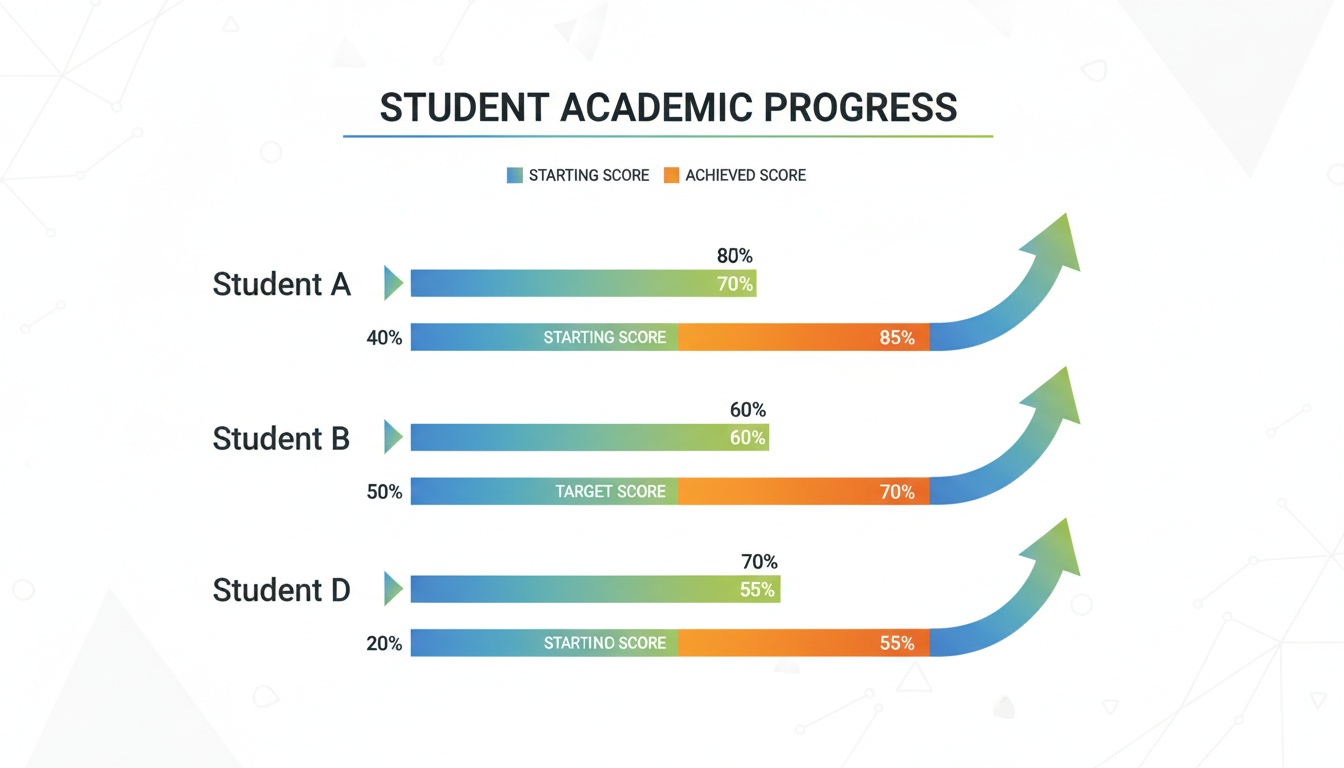
The four profiles below reflect patterns we observe regularly among Vancouver-area students we work with. Names are illustrative; the score trajectories and study approaches represent real outcomes we see across different prep formats.
Profile 1: West Van Student, In-Person Group Course — 1150 → 1380
Starting score: 1150. Target: 1350. Achieved: 1380.
Daniel started prep roughly five months before his June test date. He enrolled in a 28-hour in-person group course and attended every session — which sounds obvious, but a meaningful share of enrolled students miss multiple classes.
His turning point came in week four, when he started reviewing his practice test errors before looking at the answer explanations. That one habit change — actually diagnosing his own reasoning before being told the answer — accelerated his math accuracy in a way that showed up immediately on his next practice test.
"I kept getting the same algebra questions wrong for different reasons each time. Once I started writing down why I thought my answer was right, I started seeing the pattern."
Timeline: approximately 5 months. Weekly study hours: 6–8.
Profile 2: Richmond International Student, Private Tutoring — 1080 → 1390
Mei's situation was different — a stronger starting point in math, but a bigger reading gap, and a tighter budget for time.
Starting score: 1080. Target: 1400. Achieved: 1390.
Mei came to Canada in Grade 10 with strong math but reading and writing scores pulling her composite down. Her family invested in private SAT tutoring at roughly two sessions per week over four months.
The tutor spent the first three weeks entirely on reading comprehension strategy — not vocabulary memorization. Most students assume vocabulary is the problem. Usually it isn't. It's inference speed and evidence-selection under time pressure.
"My tutor made me explain out loud why I was eliminating each wrong answer. It felt slow at first. Then my reading score jumped 80 points in six weeks."
Timeline: approximately 4 months. Weekly study hours: 8–10.
Profile 3: Burnaby Self-Studier, Khan Academy Only — 1290 → 1420
Marcus had neither of Priya's advantages — a small gap and genuine self-direction. Her story shows what's possible when both conditions are met.
Starting score: 1290. Target: 1400. Achieved: 1420.
Priya was already a strong student at a Burnaby high school. She used Khan Academy's full program for several weeks, averaging about 5 hours per week, and took multiple full-length timed practice tests before her actual test date.
Her gap was small enough that structured support wasn't necessary. She also had the discipline to treat her practice tests like real test days — same time of morning, no phone, timed strictly. Self-study worked here because the gap was manageable and the student was genuinely self-directed.
Profile 4: Coquitlam Late Starter, Intensive Tutoring — 1100 → 1310
This is Marcus's story from the opening. Starting score: 1100. Target: 1350. Achieved: 1310.
Six weeks of intensive prep moved the needle 210 points — a real result, but short of his target. He got above the merit scholarship threshold at his target schools. He didn't get the buffer he wanted.
Start early. Six weeks of intensive prep can move the needle; 4–5 months gives you room to actually consolidate what you learn.
What These Profiles Have in Common
Every student who hit or exceeded their target did three things:
- Took at least three full-length timed practice tests before test day
- Started with a diagnostic rather than guessing about their weaknesses
- Matched their prep method to how they actually learn — not how they wished they learned
The students who fell short almost always started too late.
SAT vs. ACT: A Quick Note for Vancouver Students
Most Vancouver families focus on the SAT by default. Worth knowing: many US universities accept both the SAT and ACT interchangeably, and some students score better on one than the other.
The ACT has a science reasoning section; the SAT's math section is more algebra-heavy. If a student is strong in science but weaker in algebra, the ACT is worth a diagnostic attempt before committing to months of SAT prep. Taking one free practice test for each is a low-cost way to find out which test plays to your strengths.
Assuming the SAT is your test, here's how to choose a prep format that fits your timeline and budget.
SAT Prep Options in Vancouver: In-Person, Online, and Private Tutoring Compared
| Method | Typical Cost | Schedule Flexibility | Personalization | Best For |
|---|---|---|---|---|
| Self-study | $0–$50 | Maximum | None | Disciplined students, small score gaps |
| Online programs | $150–$500 | High | Low–moderate | Busy students, moderate gaps |
| In-person group courses | $800–$2,000 | Low | Low | Students needing structure and accountability |
| Private tutoring | $1,200–$3,000+ total | Moderate | High | Large gaps, targeted weaknesses, international students |
Prices as of 2026; confirm with providers before booking.
Cost-per-point-gained is a more useful frame than sticker price. If a $1,500 group course produces a 150-point gain, that's $10 per point. If $300 of online prep produces the same result for a self-motivated student, that's $2 per point.
In-Person SAT Prep Courses in Vancouver: When Accountability Beats Self-Discipline
Some commercial test-prep providers maintain Vancouver teaching centres at central locations convenient for students coming from Burnaby or taking the Canada Line. Classroom courses typically run approximately 28 hours total, which works out to roughly 6–8 weeks depending on session scheduling.
Ask any provider you're evaluating whether their curriculum reflects the current digital SAT format — the test moved to a fully digital, adaptive format internationally in March 2023 and in the US in March 2024, and some older materials haven't caught up. Adaptive modules, different pacing strategy, no essay. This single check can save you from spending weeks on strategies that won't transfer to test day.
Several other commercial test-prep providers serve the Vancouver and Burnaby markets, including options in Victoria and other BC cities. One operates primarily online for BC students — no Vancouver physical classroom, but their on-demand video course works well for students comfortable with self-paced learning.
What in-person SAT prep courses give you that nothing else does: a scheduled room, peers who show up, and an instructor you have to face if you didn't do the homework. For students at Burnaby North or Coquitlam who struggle with self-accountability, that structure matters more than any curriculum feature. Students who've started self-study twice and quit both times should take this seriously — external accountability is often the difference between a 50-point gain and a 150-point gain.
Online SAT Prep Programs: Best for Students Already Above 1200
Khan Academy is the College Board's official free partner, and for a student with a 200-point gap and strong self-discipline, it's competitive with paid platforms on its own terms. The adaptive practice technology is solid.
Beyond Khan Academy, several commercial providers offer online versions of their classroom courses — often the same curriculum delivered via video. The flexibility advantage is real for students balancing AP or IB coursework at schools like U Hill or Magee. The tradeoff is accountability: without a scheduled class, many students drift.
Online SAT prep tends to work best for students already scoring above 1200 who need targeted polish, not a full rebuild.
The Digital SAT: What Changed and Why It Matters
The current SAT is fully digital and adaptive. Your second math module gets harder or easier based on your first module performance — which means pacing strategy is genuinely different from the old paper test. See our digital SAT format guide for a full breakdown of what changed.
Some older curriculum resources haven't been fully updated for the adaptive format. Ask any tutor or program directly: are your materials built for the current digital SAT, not the pre-2023 paper version?
Private SAT Tutoring in Vancouver: Targeted Prep for Large Score Gaps
Private SAT tutoring is the most expensive option per hour — typically $60–$150/hr depending on the tutor's credentials and experience (2026 Vancouver market rates; confirm with individual tutors). It's also the only format that adapts to your specific error patterns rather than teaching a fixed curriculum to everyone.
When evaluating Vancouver tutors, ask three things: What's your background with the digital SAT specifically? Can you share anonymized score improvement data from past students? Do you use official College Board practice tests or third-party materials?
One instructor profile worth examining when vetting Vancouver SAT tutors: Irene S. She has been teaching SAT and GRE prep for many years, holds a master of arts in teaching from a US university, and spent a decade as a public high school science teacher before moving into test prep. That kind of background — real classroom teaching, not just high personal test scores — makes a real difference in how concepts get explained. Students she's worked with have reported score gains typically in the range of 100–200 points over 10–12 weeks, though individual results vary. (Disclosure: Irene S. teaches for a commercial test-prep provider with a Vancouver teaching centre.)
For more options, browse our Vancouver SAT tutors to compare backgrounds and specializations.
Self-Study and Free SAT Prep Resources
Self-study with Khan Academy and the College Board's free full-length practice tests is sufficient for some students — specifically those already within 100 points of their target. If your diagnostic score is within 100 points of your target and you're the kind of person who finishes what you start, you may not need to spend anything beyond the test registration fee.
Most students overestimate their self-motivation. After two weeks of solo prep, life at York House or St. George's gets busy, and the SAT prep folder sits unopened.
A Note for International Students in Richmond and the Westside
International students in Richmond and the Westside disproportionately benefit from private tutoring — and the reasons go beyond math strategy.
SAT reading passages embed cultural assumptions that native English speakers absorb without noticing. References to American civic institutions, literary traditions, and rhetorical conventions can slow inference speed for students who learned English as a second language, even when their grammar and vocabulary are strong.
This is where many international students plateau: not at 900 or 1000, but at 1150–1250, where reading comprehension speed becomes the binding constraint.
Worth knowing: there are no ESL-specific SAT prep resources that meaningfully address this. The better approach is working with a tutor who can identify exactly which passage types are slowing you down — science passages, historical documents, literary fiction — and drilling those specifically. Vocabulary memorization is rarely the answer. Evidence-selection speed under time pressure usually is.
Cost Breakdown: How Much Does SAT Prep Cost in Vancouver?
| Option | Typical Cost | Notes |
|---|---|---|
| Self-study (Khan Academy + College Board materials) | $0–$50 | Test registration ~$68 USD (as of 2026) |
| Online prep programs | $150–$500 | Varies widely by platform |
| In-person group courses | $800–$2,000 | 28-hour programs typical |
| Private tutoring (12-hr package) | $720–$1,800 | $60–$150/hr depending on tutor |
| Private tutoring (full engagement, 3–5 months) | $1,800–$4,500+ | 2–3 sessions/week |
All figures are 2026 estimates. Confirm current pricing directly with providers.
One thing most Vancouver families don't realize: the College Board charges approximately $68 USD for SAT registration (as of 2026), but late registration adds another $30, and score sends beyond the four free reports cost $13 each. A student applying to eight US schools can easily spend $150+ in College Board fees alone before touching prep costs. Budget for this separately.
For a 100-point gain with minimum viable investment: Khan Academy plus multiple full official practice tests is a strong starting point for students already scoring above 1200. Affordable SAT prep doesn't have to mean a paid program.
International students often face higher stakes — a score gap that affects scholarship eligibility can represent tens of thousands of dollars in lost aid. In that context, investing in private tutoring is a reasonable calculation, not an extravagance.
How to Choose the Right SAT Prep Method: 4 Questions That Predict Your Success
Before you book anything, answer these four questions honestly.
1. How many months until your test date?
- Less than 8 weeks: private tutoring or intensive online
- Three to six months: any format works
- Start with a diagnostic first regardless
2. What's your current score vs. target?
- Gaps under 100 points: self-study is probably enough
- Gaps of 150–250: group course or online program
- Gaps above 250, or significant weakness in one section: private tutoring
3. Do you need external accountability?
If you've started self-study twice and stopped both times, that's your answer. In-person group courses or scheduled private tutoring will outperform any online platform you don't actually open.
Most students get this question wrong.
4. What's your budget?
There's a real option at every price point. Don't spend money you don't have on a format that isn't right for you.
If you've answered these questions and still aren't sure which format fits, book a free SAT prep consultation — we'll review your diagnostic score, timeline, and target schools and give you a straight answer.
Building Your SAT Prep Timeline: When to Start Based on Your Score Gap
| Timeline | Score Gap | Recommended Approach |
|---|---|---|
| 3 months out | Under 100 points | Timed practice tests and error review |
| 4–5 months out | 100–200 points | Diagnostic → weak areas → full-length practice |
| 6+ months out | 250+ points or cold start | Private tutoring or structured group course |
Key milestones in order: diagnostic test → structured prep on weak areas → first full-length timed practice test → mid-prep diagnostic → second full-length practice test → SAT test day preparation including logistics, sleep, and timing.
For a deeper look at what realistic score gains look like by starting score band, see our Vancouver SAT prep score improvement guide.
Getting Started: Your Next Steps for SAT Prep in Vancouver
Take a free full-length diagnostic test first — before you book anything. Your score tells you which format you need.
Register for your test date at the College Board website. Vancouver-area students have several BC SAT test centres available. Shortlist two or three providers or tutors and ask them one specific question: what was the average score improvement for your students last year?
Set a target score based on the actual admission ranges at your target schools. Not a round number. Not a wish. The real median score for admitted students at each school on your list.
College Board official SAT practice and registration page
BC Ministry of Education graduation requirements
The best SAT prep method is the one you'll actually follow through on. Brand name matters less than format fit. We've seen students at Crofton House and West Point Grey achieve identical score gains through completely different prep paths — because they each chose the method that matched how they work.
If you want a second opinion on which approach makes sense for your specific situation, book a free SAT prep consultation and we'll walk through your score, your schools, and how much time you have together.
Key Takeaways
- Cost-per-point-gained matters more than sticker price when comparing prep options
- A 100-point SAT gain is achievable in 8–10 weeks with consistent effort; 200+ points typically requires 3–5 months
- In-person courses suit students who need accountability; private tutoring suits large gaps or specific weaknesses
- Khan Academy is competitive with paid platforms for students already above 1200 with small gaps
- International students in Richmond and the Westside benefit most from private tutoring — reading comprehension speed, not vocabulary, is usually the constraint
- The digital SAT is adaptive — pacing strategy differs from the old paper test; confirm prep materials reflect the current format
- Starting 4–6 months before your target test date gives you time to build skills, not just memorize strategies
- Budget separately for College Board fees — registration, late fees, and score sends can add up to $150+ before prep costs