SAT Prep in Grade 9: Your Multi-Year Roadmap to a Top Score
Most Grade 9 students in Vancouver aren't thinking about the SAT yet. That's fine — unless they want to apply to a US university, in which case the decisions they make in freshman year will quietly determine their ceiling two years from now.
The students who use freshman year strategically — building real skills rather than grinding practice tests — consistently outperform peers who scramble in Grade 11. We've tracked this pattern across 300+ students in Richmond, Burnaby, Coquitlam, North Vancouver, and West Vancouver over the past five years. It's not close.
The short answer: yes, Grade 9 is the right time to start — but not with practice tests. This is about building the reading habits, algebra fluency, and analytical skills that the SAT actually rewards. Two years of consistent, low-pressure work beats two months of panic-driven drilling. Here's the roadmap.

Myths About Starting Early (And What the Research Actually Shows)
Two things parents bring up constantly: "My kid's counsellor said not to worry about the SAT until Grade 11" and "I heard starting early makes a huge difference." Both contain some truth. Neither tells the whole story.
Starting SAT prep in Grade 9 doesn't mean buying a 700-page test-prep book and running timed practice tests every weekend. That's early burnout, not early preparation.
Instead: build the reading habits, algebra fluency, and analytical writing skills that the SAT tests — skills that take years to develop. A student who reads broadly and works through challenging courses in Grades 9 and 10 arrives at Grade 11 with a foundation that two months of intensive cramming simply cannot replicate.
Myth 1: Early SAT prep will hurt your GPA.
Wrong. Done correctly, early test prep reinforces what students are already learning in school. A Grade 9 student strengthening algebra fundamentals isn't sacrificing GPA — they're deepening it.
Myth 2: The SAT is too far away to matter.
Improvement in standardized testing compounds over time. A student who closes a reading comprehension gap in Grade 9 carries that skill into every English class, every PSAT, and eventually the actual SAT. Two years of gradual, consistent work beats two months of panic-driven drilling.
This article isn't a list of tips. It's a three-year prep timeline — one that treats freshman year as the foundation it actually is.
Understanding the PSAT 8/9: Your Diagnostic Roadmap for Two Years of Targeted Prep
The PSAT 8/9 is a College Board assessment designed specifically for Grade 8 and 9 students. It covers reading, writing, and math — the same domains as the SAT — but calibrated to where students actually are developmentally.
The scoring scale runs from 240 to 1440, which is lower than the SAT's 400–1600 range. That's intentional. It reflects grade-level expectations, not college-ready benchmarks.
The SAT is fully digital, delivered through College Board's [Bluebook app](INTERNAL_REF: digital SAT format guide) — and the PSAT 8/9 has also been digital since fall 2023. If you're looking at older paper-based practice materials, they're outdated. Use College Board's current digital practice tools.
PSAT 8/9 vs. PSAT 10 vs. SAT: What's the Difference?
The PSAT 8/9 is a diagnostic baseline for Grade 9. The PSAT 10 tracks Grade 10 progress. The PSAT/NMSQT (Grade 11 only) qualifies for National Merit. The SAT is the college admissions test.
| Test | Grade Level | Score Range | Primary Purpose | Scholarship Eligibility |
|---|---|---|---|---|
| PSAT 8/9 | Grades 8–9 | 240–1440 | Diagnostic baseline | None |
| PSAT 10 | Grade 10 | 320–1520 | Skill tracking | None |
| PSAT/NMSQT | Grade 11 | 320–1520 | College readiness + National Merit | Yes — National Merit Semifinalist |
| SAT | Grades 11–12 | 400–1600 | College admissions | N/A |
The PSAT 8/9 tells you where you are. The PSAT 10 shows you how far you've come. The PSAT/NMSQT is the one that matters for National Merit Semifinalist consideration — that's the Grade 11 test only, not the Grade 9 version. The SAT is the finish line.
A few things worth knowing about the PSAT 8/9 specifically: scores don't go to colleges, and they play no role in National Merit Semifinalist consideration. Schools in BC can administer the PSAT 8/9 from September through April in the current school year — confirm with College Board for any changes, and check with your school's counselling office directly.
There's no guessing penalty on the PSAT 8/9. Answer every question.
Practically speaking, a "good" PSAT 8/9 score for a Grade 9 student in Vancouver isn't a fixed number — it's a diagnostic tool. The value isn't in the score itself; it's in the score report, which breaks down performance by skill area and tells you exactly where to focus over the next two years.
Think of the PSAT 8/9 as a starting gun, not a report card. (That metaphor is a bit worn, but it's accurate — so we're keeping it.)
Your Three-Year Roadmap: What to Focus on Each Grade
This is the section most prep guides skip. They give you tips. This gives you a timeline.
Here's how to structure each year:
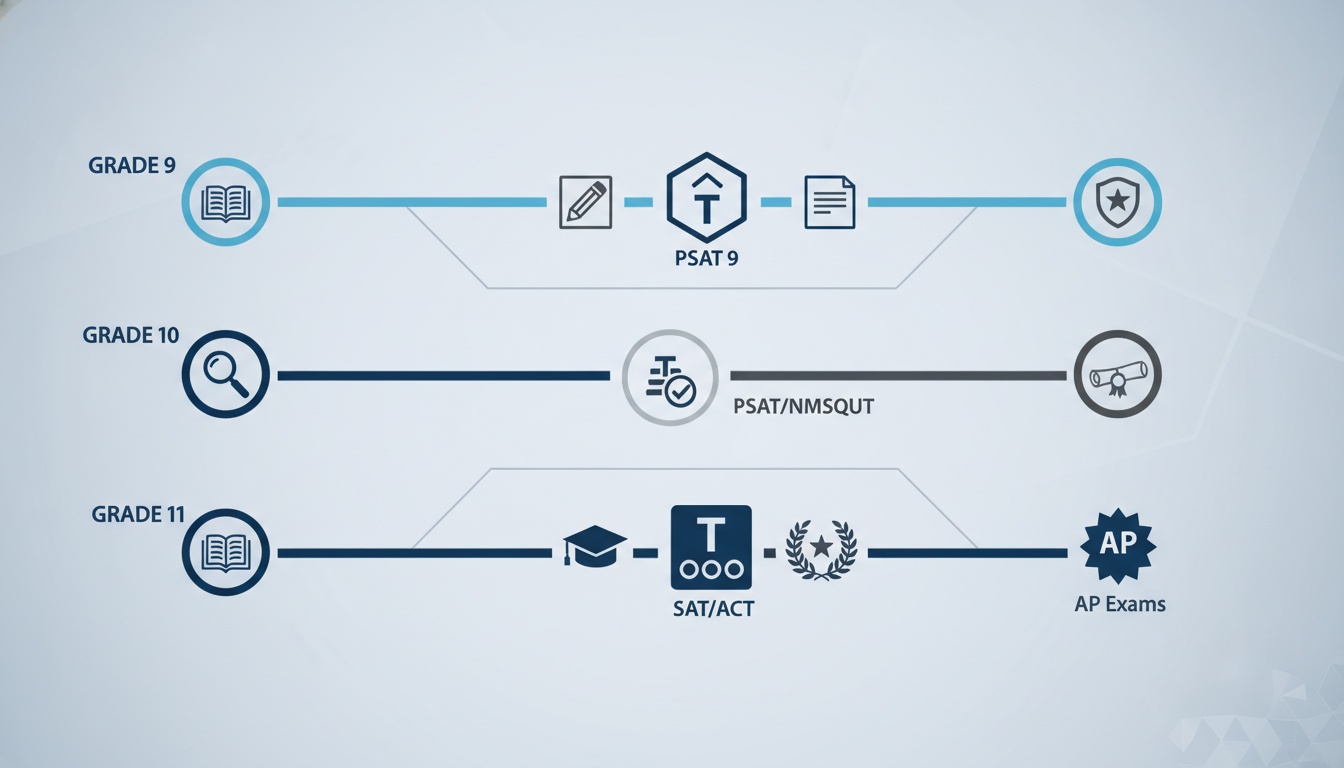
Grade 9: Foundations (Not Flashcards)
What to focus on: Reading widely and often. Strengthening algebra and geometry. Taking the most challenging courses your school offers — whether that's Pre-AP at Burnaby North, advanced English at Sentinel, or the accelerated math stream at U Hill.
Time commitment: 15–20 minutes, three to four days per week. No full practice tests yet.
Key milestones:
- Take the PSAT 8/9 to establish a baseline score.
- Read the score report carefully and identify one or two weak areas to address through schoolwork, not supplemental drilling.
The goal in Grade 9: become a stronger reader and a more confident math student. The SAT will reward that later.
Not sure where your student stands right now? A 30-minute consultation can map out exactly where to focus in Grade 9 — no commitment required.
Grade 10: Skill-Building
What to focus on: Introduce timed practice sections (not full tests). Take the [PSAT 10](INTERNAL_REF: PSAT 10 score interpretation guide). Start working through practice questions by skill area, particularly in math topics your Grade 10 courses are covering.
Time commitment: 20–30 minutes, four days per week. One timed section per week by second semester.
Key milestones: PSAT 10 in spring. Compare results to your Grade 9 PSAT 8/9 baseline. If you're seeing meaningful gaps, this is when light tutoring or a structured prep program starts making sense.
Grade 11: Test-Taking Strategy
What to focus on: Full-length practice tests under real conditions. Test-taking strategy — pacing, process of elimination, educated guessing on the digital adaptive format. The ACT vs. SAT decision. An official SAT attempt in spring.
Time commitment: 45–60 minutes, four to five days per week in the semester before your test date.
Key milestones: First official SAT attempt, ideally March or May of Grade 11. Registration for March and May test dates typically opens in January — seats at popular test centres in Metro Vancouver fill within days. Register the week registration opens. Review results. Decide whether to retake. For students considering retakes, our SAT retake strategy and long-term planning guide walks through the data on when retaking makes sense.
ACT vs. SAT: Which Test Should a 9th Grader Plan For?
Most students should run a diagnostic for both tests in Grade 10 before committing — don't default to the SAT without checking. The [ACT](INTERNAL_REF: ACT vs. SAT comparison guide) is worth serious consideration if your student excels at science reasoning and prefers a more straightforward math section with less inferential problem-solving.
The decision doesn't need to be made in Grade 9. Take one diagnostic practice test for each in Grade 10 before committing. Don't assume the SAT is automatically the right choice.
The short version: if your student finds the SAT's evidence-based reading format frustrating but moves quickly through science-style data questions, run an ACT diagnostic before investing two years of prep in the wrong test.
What Math and Reading Topics Does the SAT Test vs. What 9th Graders Are Learning?
Grade 9 students can immediately build reading fluency and algebra foundations. Geometry, advanced algebra, and rhetorical analysis are Grade 10–11 content. This alignment means Grade 9 prep should focus on foundational skills, not advanced topics.
| SAT Math Topics | Typical Grade 9 Math Curriculum |
|---|---|
| Linear equations and inequalities | Algebra I / Math 10 (BC) |
| Systems of equations | Algebra I — second semester |
| Data analysis and statistics | Some exposure in Science 9 |
| Geometry and trigonometry | Geometry (Grade 10 for most students) |
| Advanced algebra | Mostly Grade 10–11 content |
| SAT Reading/Writing Topics | Typical Grade 9 English Curriculum |
|---|---|
| Evidence-based reading comprehension | English 9 — literary and informational texts |
| Vocabulary in context | English 9 — ongoing |
| Grammar and sentence structure | English 9 — writing units |
| Rhetorical analysis | Introduced in Grade 10–11 |
That's not a problem. It's a reason to use Grade 9 wisely rather than rushing into content that won't land yet.
Balancing Test Prep With Freshman Year (Without Burning Out)
GPA comes first in Grade 9.
A student earning 95% in English 9 is doing more for their SAT Reading score than a student at 80% who spends weekends on prep books. Grades matter for college admissions, and they matter for building the actual skills the SAT tests.
The balance framework we recommend: 15–20 minutes per day, three to four days per week, focused on reading or one specific math skill.
Sample weekly schedule for a Grade 9 student:
- Monday: 20 minutes of independent reading (fiction, non-fiction, news — variety matters)
- Tuesday: Off
- Wednesday: 15 minutes reviewing one algebra concept from class
- Thursday: 15 minutes of vocabulary in context — a news article from The Atlantic or a Khan Academy passage both work
- Friday/Weekend: Off — sports, friends, rest
Under 90 minutes per week. It compounds.
Five Mistakes That Derail Early Test Prep
Mistake 1: Treating the SAT like an 11th-grade problem. Procrastination feels rational until Grade 11 hits and there's no runway left for real improvement.
Mistake 2: Drilling full practice tests before foundational skills are solid. A student who can't reliably solve systems of equations will just practice getting those questions wrong. Build the skill first.
Mistake 3: Dismissing the PSAT 8/9 as "not real." It's the only diagnostic test calibrated for where Grade 9 students actually are. Ignoring it means starting Grade 10 without a map.
Mistake 4: Using materials designed for Grade 11 students. Some commercial test-prep providers sell the same curriculum to every grade. A 9th grader working through 11th-grade test strategy content is skipping the foundation.
Mistake 5: Letting SAT anxiety affect freshman GPA. Some students get so fixated on a future test that they underperform in the courses building the skills they need. Keep the focus on school first.
Students who burn out in Grade 10 are usually the ones who over-prepped in Grade 9. Consistency over two years beats intensity over two months.
If your student is showing any of these patterns, a quick consultation can help reset the approach before Grade 10 momentum builds.
When Early Prep Becomes a Problem
Watch for these signals that prep has crossed from productive to harmful:
- Your student is anxious about a test that's two years away.
- Prep is cutting into sleep.
- Grades are slipping because mental bandwidth is spent on SAT worry rather than actual schoolwork.
If any of those are true, pull back. Completely.
A student who arrives at Grade 11 with strong grades, genuine curiosity, and no test anxiety will outperform a burned-out student with two years of drilling behind them. The SAT rewards calm, focused thinking — not exhausted familiarity with question formats.
Free and Paid Resources That Actually Work at This Stage
How to Evaluate Prep Resources at This Grade Level
Most prep resources target Grade 11 students with six weeks until test day. A 9th grader needs something different. We've evaluated major platforms specifically for Grade 9 readiness — and the gap between what's marketed and what's actually grade-appropriate is significant.
[Khan Academy SAT prep](INTERNAL_REF: Khan Academy SAT prep walkthrough) remains the strongest free option because the skill-level breakdown matches where 9th graders actually are — not where Grade 11 students are panicking.
Free resources worth using:
- Khan Academy SAT prep — College Board's official free partner. The skill-level breakdown lets you target specific weak areas — algebra, reading comprehension, grammar — without the pressure of full practice tests. Faster skill-building, less burnout. Start here.
- College Board's PSAT 8/9 practice tests — Download directly from College Board's website. Use one as a diagnostic before or after taking the official test.
- Daily Practice for the Digital SAT app — Regularly updated to reflect the current digital SAT format. Spend 5–10 minutes per day on real questions without committing to full sections, which builds consistency without the mental load of longer sessions.
Paid resources — when do they make sense?
One-on-one tutoring in Grade 9 makes sense in two specific situations. First: a student has a significant math gap (struggling with Algebra I concepts that will appear on the SAT), which means they'll avoid compounding confusion in Grade 10. Second: a student has a learning difference that benefits from personalized pacing, which prevents frustration and keeps them engaged.
The data supports it. Research on tutoring — including a review by Matthew Kraft published by the Brookings Institution — consistently finds meaningful percentile gains for students who receive targeted one-on-one support compared to those who don't.
That's a real effect.
But it's not a reason to hire a tutor before you've identified a specific gap. Tutoring without a target is expensive and unfocused.
For students considering structured programs, evaluate whether the program is grade-appropriate. Ask directly: is this curriculum designed for Grade 9 students, or is it the same material you give Grade 11 students? The answer matters.
Red flags in programs targeting Grade 9 students: urgency-based marketing ("start now or fall behind"), outdated non-digital SAT materials, or programs that won't show you a sample curriculum before you pay.
Should a 9th Grader Take a Prep Class or Get a Tutor?
For most Grade 9 students earning strong grades in Math 9 and English 9, self-study with Khan Academy is genuinely sufficient. Save the tutoring budget for Grade 10 or 11 when specific gaps are clearer. The exception: if there are existing math gaps or learning differences, targeted one-on-one support in Grade 9 pays dividends.
Address the gap early, before it compounds.
For a deeper look at how early prep affects college admissions positioning, see our college admissions planning guide for BC students. For families considering summer programs, our guide to flexible summer SAT prep programs covers what to look for and what to skip.
Setting Realistic Goals: What Score Improvement Is Possible From 9th to 11th Grade?
Here's the contrarian take most prep guides won't say out loud: a high PSAT 8/9 score in Grade 9 is not the goal.
Effort and consistency over time matter more than starting point. We know that sounds like a motivational poster. It's also just true.
To make this concrete: one student we worked with in Coquitlam scored 860 on the PSAT 8/9 in Grade 9 — below grade-level benchmarks in both math and reading. She spent Grades 9 and 10 focused on school, read consistently, and did 20 minutes of Khan Academy three days a week. She scored 1310 on the SAT in Grade 11. No intensive boot camps. No summer programs. Just two years of compounding.
This pattern — significant improvement from consistent, low-pressure prep — is what we see repeatedly with students who avoid burnout and keep their focus on school first.
What's a reasonable Grade 9 baseline? The College Board doesn't publish a single "good" PSAT 8/9 score because the test is diagnostic, not evaluative. What matters is your score relative to the skill benchmarks in your report — and whether you're above or below grade-level expectations in each domain.
How to set grade-appropriate benchmarks:
- In Grade 9, aim to meet grade-level benchmarks in both math and reading/writing on the PSAT 8/9.
- In Grade 10, aim to close any gaps identified in Grade 9 and hit PSAT 10 benchmarks.
- In Grade 11, set a target SAT score based on the score ranges of your target schools — not a generic "good score."
That last point matters for Vancouver students applying to US universities. If you're looking at schools like UBC (which doesn't require the SAT) versus UC Berkeley, Stanford, or Northeastern, the score requirements are different. Knowing your target schools' score ranges in Grade 9 means your prep has a specific destination, not just a direction. It shapes which courses you take, which extracurriculars you prioritize, and how you position yourself in the admissions process overall.
How Early Prep Connects to College Admissions Strategy
Most families think of SAT prep and college admissions planning as separate tracks. They're not.
A Grade 9 student who knows they're targeting selective US universities can make smarter decisions right now. That means choosing IB or AP courses where available, building a coherent extracurricular narrative, and understanding what score percentile their target schools actually expect.
Score percentile context — knowing that a 1400 puts you at roughly the 95th percentile nationally — is more useful than chasing an abstract number.
The students who arrive at Grade 11 with a clear college list and two years of intentional preparation behind them aren't just better prepared for the SAT. They're better prepared for the entire application process.
Keep a simple score log — a spreadsheet with your PSAT 8/9 results, PSAT 10 results, and eventual SAT scores. If you're not seeing improvement between PSAT 8/9 and PSAT 10, that's a signal to change your approach before Grade 11, not after.
Key Takeaways
- Grade 9 SAT prep means building foundations — reading habits, algebra fluency, challenging courses — not drilling practice tests.
- The PSAT 8/9 (score range 240–1440) is a diagnostic tool, not a high-stakes test. Use the score report, not just the number.
- The SAT and PSAT 8/9 are fully digital. Use College Board's current Bluebook-compatible practice materials.
- Follow the three-year roadmap: Grade 9 (foundations), Grade 10 (skill-building and PSAT 10), Grade 11 (full test strategy and official SAT attempt).
- Keep prep to 15–20 minutes per day, three to four days per week in Grade 9. GPA and extracurriculars come first.
- Consider the ACT vs. SAT decision in Grade 10 — don't default to the SAT without running a diagnostic for both.
- Khan Academy is the right free starting point. Paid tutoring makes sense when specific gaps are identified, not as a default.
- Know your target schools' score ranges early. It makes your prep specific and your college admissions strategy sharper.
Ready to build a prep plan that actually fits your student's grade level and goals — without the burnout or the guesswork? Book a consultation with a Vancouver-based admissions consultant. We work with families across Richmond, Burnaby, Coquitlam, North Vancouver, and West Vancouver — consultations are available in-person or online — and we'll map out a realistic, multi-year path to the scores your target schools want to see.