Penn Alexander: The Public School UPenn Co-Runs in West Philadelphia (2026 Guide)
There's a public school UPenn essentially co-runs in West Philadelphia — no tuition, no entrance exam, no application — and most people outside the catchment have never heard of it. Penn Alexander School sits roughly four blocks from Penn's campus, and the gap between what it offers and what a standard Philadelphia public school offers is measurable: class sizes, curriculum depth, and PSSA outcomes all differ.
What Is Penn Alexander? The UPenn Public School in West Philadelphia
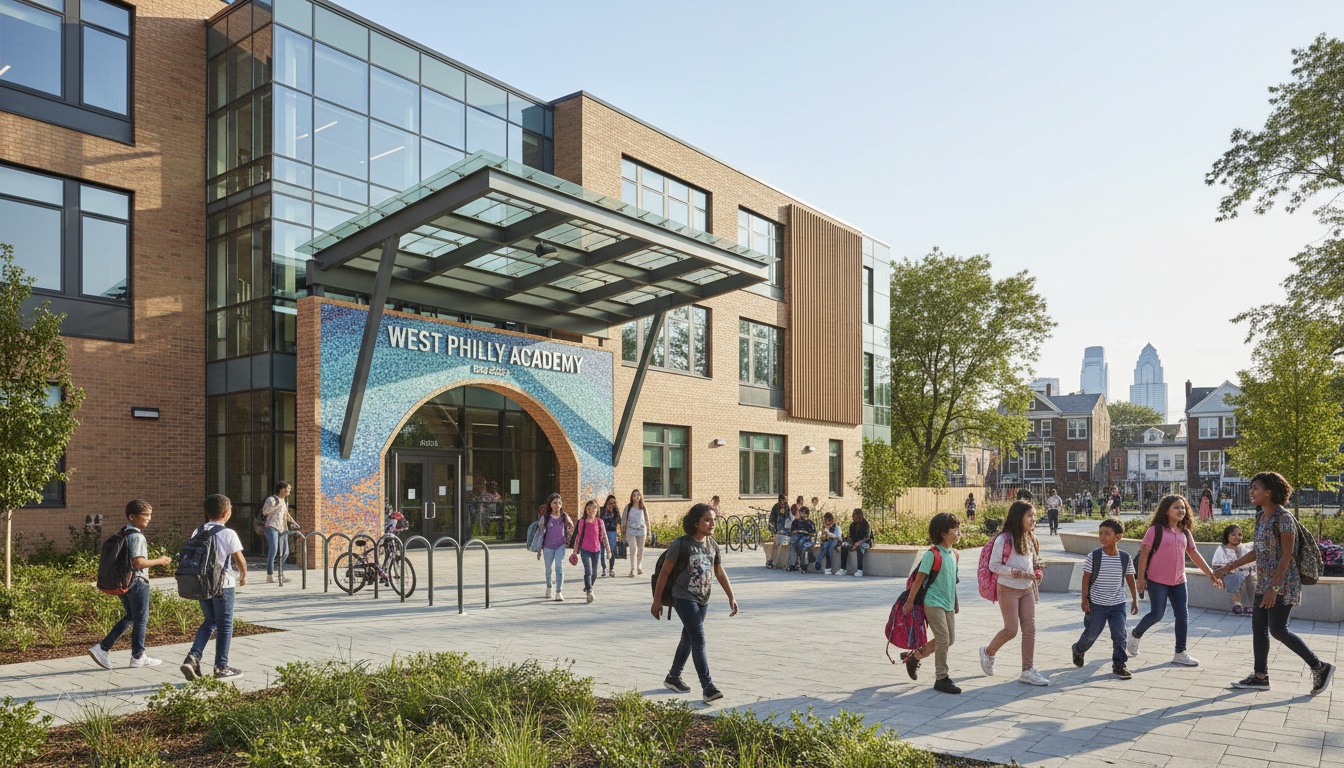
Penn Alexander School is a K-8 elementary school in West Philadelphia. It's operated by the School District of Philadelphia, charges zero tuition, and admits students based on a defined geographic catchment area — not test scores, not applications, not interviews.
Penn Alexander is public. Fully public.
The school carries the name of Sadie Tanner Mossell Alexander, a Penn graduate who became one of the first Black women to earn a PhD in economics in the United States. Naming the school after her wasn't a symbolic gesture — it was a statement about what the partnership between Penn and this West Philadelphia neighborhood is supposed to mean: academic excellence extended into the community, not hoarded behind a tuition wall.
The "university-assisted" label is the key distinction. Penn Alexander isn't a charter school. It isn't a magnet school requiring citywide testing. It isn't affiliated with Penn's undergraduate or graduate admissions in any way — a child who attends Penn Alexander has no advantage applying to Penn later, and Penn's private admissions process has nothing to do with the school's enrollment.
What the university-assisted model means is that the University of Pennsylvania contributes funding, instructional expertise, and research-based education resources above and beyond what the School District of Philadelphia provides to a standard neighborhood school. For families who live within the catchment area, it's a structural rarity in American public education: university-level resources attached to a neighborhood school, at a cost of zero.
School Leadership and Administration
Penn Alexander's principal operates within the SDP structure, not Penn's administrative hierarchy. The partnership is formalized through a memorandum of understanding between Penn and SDP, which governs funding and faculty involvement. Verify the current principal's name directly with the school.
History and Partnership: How UPenn Built This School
The origin story starts with Judith Rodin, Penn's president from 1994 to 2004. Under her leadership, Penn made an explicit commitment to West Philadelphia community revitalization — a response to decades of disinvestment in the neighborhoods surrounding campus, and to growing pressure on the university to be something other than an island of resources in a struggling city.
Penn Alexander opened in 2001 as a direct product of that commitment. That's more than two decades of a single university putting real money, annually, into a neighborhood public school.
The partnership structure deserves careful attention. Penn contributes additional per-pupil funding above the standard School District of Philadelphia allocation — historically in the range of $1,500–$3,500 per student annually above SDP baseline, based on academic literature on university-assisted schools. Confirm current figures directly with the school, as amounts shift year to year. That funding pays for things a standard SDP school simply doesn't get: smaller class sizes, enriched programming, and access to Penn's Graduate School of Education for curriculum development and instructional coaching.
What Does Penn's Funding Actually Pay For?
Penn's contribution goes toward staffing ratios, arts integration, STEM programming, and ongoing research into effective instructional approaches. Penn's Graduate School of Education faculty have shaped how teachers at Penn Alexander approach literacy and math instruction — not advising from a distance, but engaged in the actual work of the school.
A standard SDP school operates on district per-pupil funding alone. Penn Alexander operates on that baseline plus Penn's supplement. This is an honest description of what the partnership buys, not a criticism of other district schools.
The model has attracted attention from education researchers as a potential template for university-community partnerships. Boston and Chicago have attempted versions of it. The results are mixed — partial replication, significant variation, and no clear consensus that the model transfers cleanly without the specific institutional commitment Penn has maintained since 2001.
Admissions, Catchment Area, and Enrollment: How to Get In
This is where families get confused, so let's be specific.
Penn Alexander admits students based on catchment area. If your home address falls within the defined geographic boundary, your child is eligible to enroll. No test, no lottery, no application essay — just a verified home address. I've seen this misrepresented on parent forums. There is no hidden application process, no informal interview, no "right" way to get in other than living in the catchment.
The School District of Philadelphia maintains an online tool where you can enter your address to check catchment eligibility — that's the first step every family should take, and it should happen before anything else.
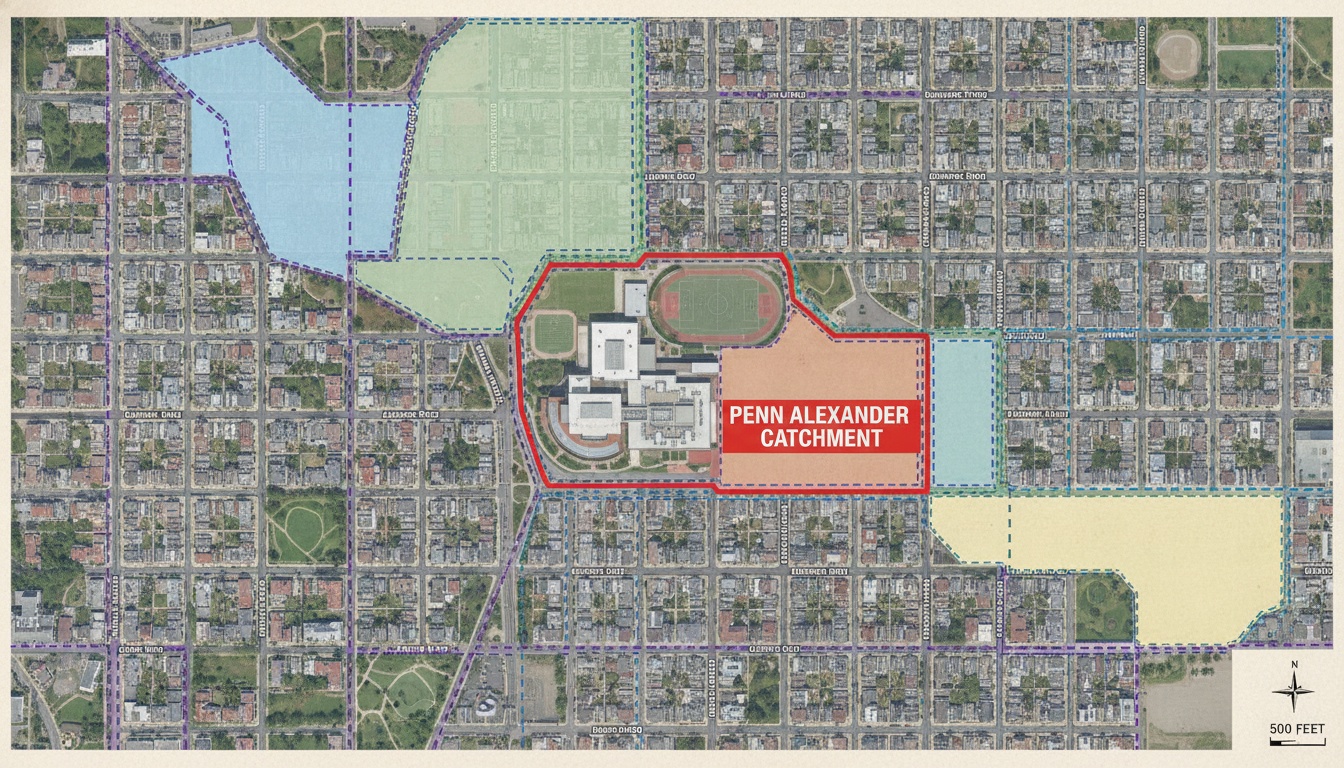
The catchment covers a specific portion of West Philadelphia — and I mean a specific portion, not "the general area." Families living just outside the boundary do not automatically qualify, regardless of how close they are. This is SDP policy, not Penn Alexander's discretion.
For the 2027–2028 school year, SDP kindergarten registration typically opens in February or March — check the SDP website for exact dates, as the district has shifted registration timelines in recent years. Required documents are what you'd expect from any public school: proof of residency (utility bill, lease), immunization records, and a birth certificate. Sibling preference applies within SDP policy — if an older child already attends, a younger sibling in the catchment gets priority.
Tuition is zero. There are no enrollment fees baked into admission. That said, most active school communities have PTA fundraising expectations and optional fees for activities — Penn Alexander is no exception. Budget roughly $500–$1,500 annually for optional activities and fundraising participation. The school is publicly funded and free to attend; the informal financial norms of the parent community are a separate conversation worth having with current families before you enroll.
Transportation eligibility follows SDP rules. Students who live within a certain walking distance of the school may not qualify for busing — the School District of Philadelphia sets those thresholds, not the school itself. Street parking near the school can be tight given the proximity to Penn's campus — and I mean genuinely tight, not "tight" the way real estate listings mean it. Families driving during drop-off and pickup should plan accordingly.
Can Out-of-Catchment Families Apply?
The waitlist is real.
Transfer requests to Penn Alexander have historically faced significant capacity constraints. Some families have pursued address changes to fall within the catchment, and SDP does verify residency. Appeals exist within the SDP system but are not a reliable path in.
If you're considering a move to West Philadelphia partly because of Penn Alexander, that's a legitimate factor to weigh. Just verify your specific address against the current catchment map before signing a lease.
Academic Programs and Curriculum: What Students Learn Here
Penn Alexander's curriculum aligns with Pennsylvania state standards — the same standards every public school in the state follows. The difference is in how those standards get taught and what gets layered on top.
Research-based instructional methods show up in the classroom as project-based learning, differentiated instruction for different skill levels, and ongoing teacher professional development informed by Penn's education faculty. The K–5 and 6–8 structures operate differently. The middle school grades include more subject-specific instruction and preparation for Philadelphia's selective high school admissions process, which students will face immediately after Penn Alexander.
8th grade comes fast — and Philadelphia's selective high schools (Central, Masterman, CAPA) require competitive applications that students will face the moment they leave Penn Alexander. The middle grades are directly structured around that reality.
Special education and IEP services are available at Penn Alexander as they are at any SDP school. Families with students who have diverse learning needs should contact the school directly to understand current service capacity and staffing. Language support for English Language Learners exists within the SDP framework, though Penn Alexander's specific ELL population is relatively small compared to some other district schools.
Extracurricular Activities and Student Life
Penn undergraduates and graduate students serve as peer mentors in reading and math — roughly one mentor per eight students — providing individualized support that typical public schools can't staff. Students interact with Penn affiliates as a normal part of the school week, not just on special occasions.
Beyond athletics and arts, the library and technology resources reflect Penn's investment above the standard SDP baseline. The school follows the standard SDP calendar, with the academic year running September through June — the SDP website has current-year specific dates.
One thing parents consistently mention in reviews: the school has a genuine neighborhood feel despite the university connection. It doesn't feel like a research lab with children in it. For families weighing whether the Penn connection makes the school feel institutional or impersonal, the consistent feedback is that it doesn't.
Academic Performance, Rankings, and What Parents Say
The most current Pennsylvania School Performance Profile data shows Penn Alexander consistently in the top tier of SDP schools on PSSA proficiency. Pull the live data at the PDE School Performance Profile rather than trusting any static number here — year-over-year figures shift, and a single-year snapshot can mislead.
School rankings on platforms like GreatSchools and Niche reflect strong parent satisfaction. Recurring themes in parent reviews: the academics are strong, the community feel is tight-knit, and the Penn resources are visible and real. The honest critiques in those same reviews center on catchment exclusivity and capacity limits that create waitlist frustration for out-of-catchment families.
Student demographics at Penn Alexander reflect West Philadelphia's diversity, with a meaningful percentage of students from lower-income households. This is not a school that has gentrified into serving only affluent families — though that tension exists in the surrounding neighborhood and in community conversations about the school. Specific demographic percentages are available through the Pennsylvania Department of Education's school profile tool.
Penn Alexander graduates have placed into Central High School and Masterman at rates that outperform most SDP middle schools — verify current placement figures directly with the school for the most recent data.
Is Penn Alexander Better Than Private Schools in Philadelphia?
For families in the catchment, choosing a $30,000/year private school over Penn Alexander is not obviously the smarter academic decision. The research-based curriculum and Penn faculty involvement produce outcomes that compete with private elementary schools. The $0 tuition is not a consolation prize — it's a structural advantage worth $180,000–$360,000 over nine years of K–8 education (at $20K–$40K private school tuition annually).
What private schools offer that Penn Alexander doesn't: selective peer environments, more individualized attention in some cases, and facilities that exceed even Penn Alexander's above-average public school resources. Those are real differences.
But "private school automatically means better education" doesn't hold up when you're comparing it to a university-assisted public school with this level of investment.
FAQs: Everything Else Parents Ask About Penn Alexander
Is Penn Alexander a public or private school? Fully public. It's operated by the School District of Philadelphia, funded by public dollars plus Penn's partnership contribution, and charges no tuition. Penn's involvement doesn't make it private — it makes it a better-resourced public school.
Do you need to take a test to get in? No. Admission is catchment-based. If your address is in the boundary, your child is eligible. There are no test scores, no interviews, no applications — just a verified home address.
What grades does Penn Alexander serve? Kindergarten through 8th grade (K–8). The school serves the full elementary and middle school range, which means families who get in at kindergarten can stay through 8th grade without reapplying.
Can Penn students volunteer or teach at Penn Alexander? Yes. Penn undergraduates and graduate students participate in mentorship and tutoring programs at the school. This pipeline is one of the more distinctive features of the university-assisted model — students interact with Penn affiliates as a normal part of the school week, not just on special occasions.
What happens after Penn Alexander — where do graduates go for high school? Philadelphia's selective high schools — Central, Masterman, CAPA — require competitive applications. Penn Alexander's 8th grade is directly structured to prepare students for these admissions, and graduates have placed into Central and Masterman at rates outperforming most SDP middle schools. Families typically begin preparation in 6th grade. Check the SDP High School Admissions Guide for current requirements.
Is there a waitlist and how long is it? For out-of-catchment families: sobering. There's no published waitlist length, but parent community forums consistently suggest that out-of-catchment placement is rare. Demand is high, seats are limited, and the school's reputation means that doesn't change year to year.
Key Takeaways
- Penn Alexander is a K–8 public school operated by SDP — tuition-free and catchment-based, not test-based or private
- Penn's partnership funds enriched programming, curriculum support, and smaller class sizes
- The school is named after Sadie Tanner Mossell Alexander, a Penn graduate and pioneering economist
- Admission is determined entirely by home address — verify against the SDP catchment tool before making any decisions
- Kindergarten registration for the 2027–2028 school year typically opens February–March — confirm exact dates with SDP directly when the time comes
- PSSA proficiency data places Penn Alexander among the top Philadelphia public schools
- For in-catchment families, the value proposition versus $20K–$40K annual private school tuition is worth running the numbers on: $0 vs. $180K–$360K over nine years
- Out-of-catchment families face significant capacity constraints; transfer requests have historically had low success rates
- The school is free to attend, though PTA participation typically runs $500–$1,500 annually — factor that in
The decisions families make in middle school shape what's possible in high school and beyond. If you're thinking through how Penn Alexander fits into a longer K–12 strategy — including what comes after 8th grade — talk to an admissions consultant about your student's specific path.