PSAT vs SAT: Key Differences Every Student Should Know
Most families treat the PSAT as a throwaway test — something you sit in October and forget about. We see this every fall: students who get their scores in December and file them away without ever opening the domain breakdown.
College Board data shows millions of high school students sit one of these two tests in a given school year. The PSAT vs SAT gap — in score scale, difficulty, and purpose — is smaller than most families assume, and understanding it can cut your SAT prep time significantly.
Short version: the PSAT tops out at 1520, the SAT at 1600, both use identical question types, and only the SAT goes to colleges. The details below explain what that actually means for your prep.
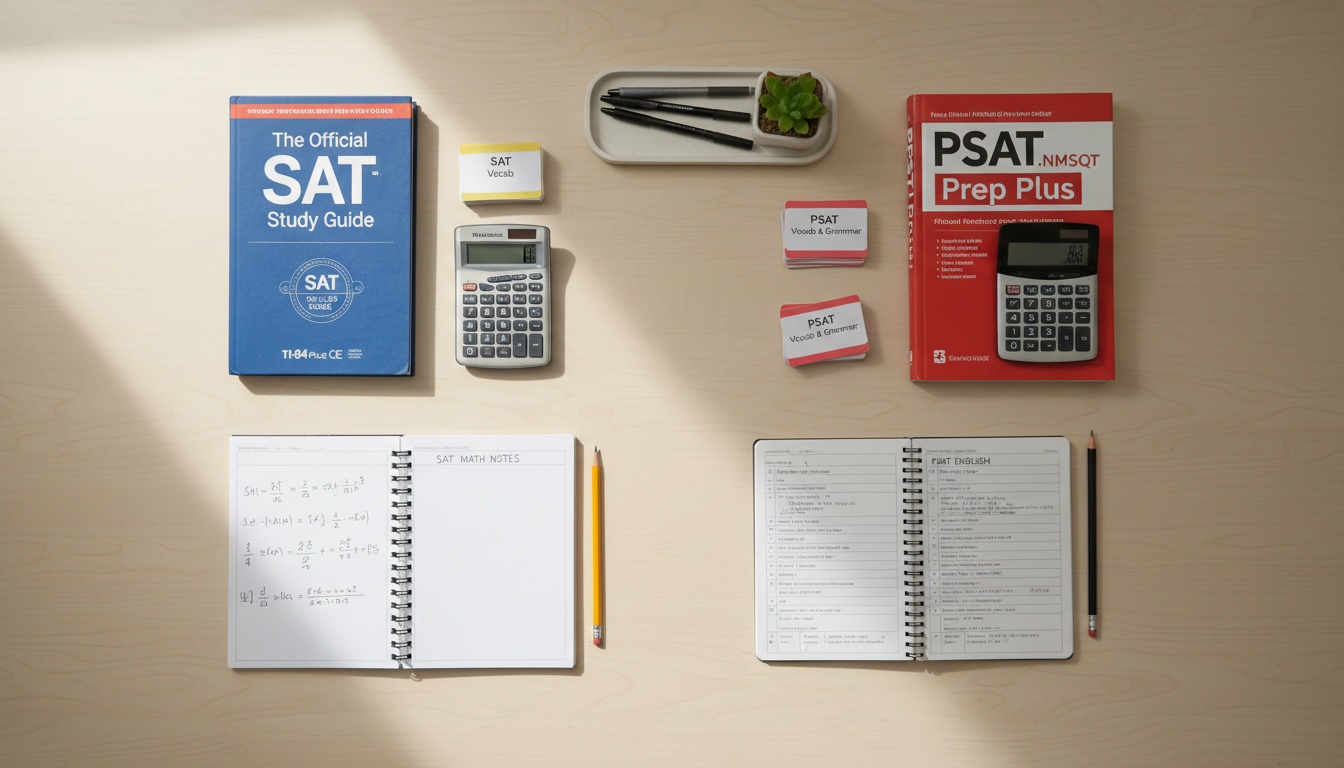
PSAT vs SAT at a Glance: Quick Comparison Table
Here's what actually matters — a side-by-side breakdown of the key dimensions that separate these tests:
| Feature | PSAT/NMSQT | SAT |
|---|---|---|
| Score Scale | 320–1520 | 400–1600 |
| Section Max | 760 per section | 800 per section |
| Test Length | ~2 hrs 14 min | ~2 hrs 14 min |
| Format | Digital adaptive | Digital adaptive |
| Cost | Free or low-cost (school-administered) | ~$60 USD per sitting (verify current fee at collegeboard.org) |
| Who Takes It | Grades 10–11 (PSAT/NMSQT) | Grades 11–12 (primarily) |
| When Offered | Fall (PSAT/NMSQT) | 7 dates/year (Mar, May, Jun, Aug, Oct, Nov, Dec) |
| College Admissions | Not submitted | Submitted directly |
| Primary Purpose | Diagnostic + National Merit qualification | College admissions |
Think of the PSAT as a diagnostic test with scholarship upside — College Board doesn't send those scores to colleges.
Understanding the PSAT Suite: 8/9, NMSQT, and the Current Pathway
Here's where most families get confused. "PSAT" isn't a single test.
PSAT 8/9: The Early Readiness Check
The PSAT 8/9 is designed for 8th and 9th graders, with a score range of 240–1440 (section max: 720). It's a college readiness check — a way to benchmark skills early enough to actually do something about gaps. Your score report from this test is worth reading carefully.
The College Board pathway is structured as a three-tier sequence: PSAT 8/9 → PSAT/NMSQT (or PSAT 10 in spring of 10th grade) → SAT.
This three-tier structure is intentional: each test is a scaffolded step in a college readiness pathway, not a standalone event.
What Is the PSAT/NMSQT and Who Qualifies for National Merit?
The version that actually matters for most families, though, is the PSAT/NMSQT — administered in the fall of 11th grade (and optionally 10th grade). This is the version that qualifies students for National Merit Scholarship consideration.
Historically, roughly 1.5 million students sit the PSAT/NMSQT each fall, and only about 50,000 qualify for National Merit recognition. The Selection Index score (calculated from your section scores) determines whether you're Commended, a Semifinalist, or a Finalist.
Cutoff scores vary by state. California Semifinalist cutoffs have historically landed around 221–223 on the Selection Index, while states like Wyoming or North Dakota have run closer to 207–209. Check NMSC's published state cutoffs each fall — they shift year to year.
Only 11th graders sitting the PSAT/NMSQT are eligible for National Merit. A 10th grader who takes it does not qualify, regardless of score.
This is the one PSAT outcome that can actually appear on a college application. Treat the fall of Grade 11 like a real test.
Key Differences: Score Scale, Length, Content, and Test Difficulty
The 80-point gap between 1520 and 1600 isn't random. It's deliberate design. The SAT includes harder questions at the upper end — questions the PSAT omits because they're calibrated for students who've had more instruction time.
Where the gap widens most is on the math section, specifically in advanced algebra and data analysis. The reading and writing section gap is narrower. It comes down to a few harder inference and rhetoric questions at the top of the difficulty range.
Test length is nearly identical: approximately 2 hours 14 minutes for both the SAT and the PSAT/NMSQT in the current digital adaptive format. This surprises most students who expect the SAT to feel much longer.
Both use a two-module adaptive structure where your Module 1 performance determines whether Module 2 is harder or easier — which means early accuracy matters more than speed. Identical mechanism, both tests.
Here's what I tell every student who walks in convinced the PSAT is a warmup: it's not meaningfully easier than the SAT for most score ranges. The difficulty gap only matters at the very top (above 1400 on the SAT). For a student targeting 1200–1350, the tests are functionally the same experience.
The bottom line: roughly 95% of the skills tested overlap between the two exams. That's the structural reality of how College Board designed the suite.
What Each Section Actually Tests
The Reading and Writing section covers four domains: Information and Ideas, Craft and Structure, Expression of Ideas, and Standard English Conventions. Each domain tests a distinct skill set — from reading comprehension and vocabulary in context to rhetorical synthesis and grammar.
Both the PSAT and SAT test all four domains. The SAT simply pushes harder on inference and rhetoric at the top end.
The Math section covers Algebra, Advanced Math, and Problem-Solving and Data Analysis, plus a smaller Geometry and Trigonometry component. On the SAT, Advanced Math questions get more complex: multi-step problems, systems with multiple variables, scatterplot interpretation requiring inference beyond the data shown. Those question types appear on the SAT but are less prominent on the PSAT.
Are the Question Types the Same on Both Tests?
Yes — both use multiple choice, student-produced responses, and passage-based questions. Practicing one genuinely prepares you for the other, which is the core argument for treating PSAT prep as real SAT prep rather than a separate exercise.

Test-Taking Strategy: How to Avoid PSAT Habits That Hurt Your SAT Score
The adaptive structure is identical, but the stakes change how you should approach each test.
On the PSAT, the difficulty ceiling is lower. That can create a false sense of comfort — students finish Module 1 feeling confident, then carry loose time management habits into the SAT. The SAT rewards deliberate pacing in a way the PSAT doesn't always demand.
On both tests, guessing is never penalized. Answer every question. A student who rushes Module 1 and makes careless errors may get routed to the easier Module 2, capping their score potential before the second half begins. So early accuracy matters more than speed.
One practical difference: the PSAT's lower difficulty ceiling means you can reach a near-perfect PSAT score with a slightly smaller skill set — but this also means a perfect PSAT doesn't guarantee a perfect SAT, so don't let early success create false confidence.
What Does a 1200 on the PSAT Equal on the SAT?
Short answer: roughly the same.
Because the PSAT and SAT share the same underlying scale, a 1200 on the PSAT is approximately equivalent to a 1200–1250 on the SAT. The slight upward adjustment accounts for marginally harder questions at the upper-middle range of the SAT.
Use this as a rough planning guide — not a guarantee:
| PSAT Score | Estimated SAT Equivalent |
|---|---|
| 1000 | 1000–1020 |
| 1100 | 1100–1120 |
| 1200 | 1200–1250 |
| 1300 | 1310–1370 |
| 1400 | 1420–1480 |
These equivalencies reflect College Board's concordance research. Verify current tables at collegeboard.org before making prep decisions.
Score conversion is an estimate, not a guarantee. Test prep timing, test-day conditions, and how much a student has grown academically between tests all affect the outcome.
College Readiness Benchmarks: What's a Good PSAT Score?
College Board's college readiness benchmark for PSAT/NMSQT is approximately 480 for Reading and Writing and 510 for Math (section scores). Meeting both benchmarks suggests a 75% probability of earning a C or better in a related first-year college course.
Scoring below benchmark in one section isn't a crisis. It's a signal. That's exactly what the diagnostic is designed to surface.
Strategic Testing Timeline: When to Take Each Test
We've seen students at schools across the Lower Mainland — from Sentinel in West Vancouver to Burnaby North — waste their Grade 11 fall PSAT because nobody told them it mattered. The testing timeline below prevents that.
Grade 8–9: Take the PSAT 8/9 if your school offers it. Use the score report to identify early gaps in college readiness. Don't stress the score — stress the diagnostic data.
Grade 10: 10th graders can take the PSAT 10 in the spring or the PSAT/NMSQT in the fall if their school offers it. Remember: a 10th grader does not qualify for National Merit regardless of score. Your score report from this test is worth acting on. Start light SAT prep — this is reconnaissance, not combat.
Grade 11, fall. This is the one. The PSAT/NMSQT is your National Merit qualifying attempt — treat it like the real thing, because for National Merit purposes, it is. Do at least one full practice test beforehand, review any prior score reports, and know your weak domains going in.
Grade 11 (Spring) / Grade 12: Begin official SAT attempts. SAT test dates run across seven opportunities each year: March, May, June, August, October, November, and December. Students who use PSAT diagnostic data strategically tend to need fewer SAT attempts because they're not studying everything; they're studying the right things.
Cost matters here too. The PSAT is typically free or low-cost through schools. The SAT registration fee is currently around $60 USD per sitting at test centres — verify the current fee at collegeboard.org, as pricing can change (there are several test centres in Metro Vancouver; check College Board's test centre locator for current listings). Fewer SAT test dates in 2026 needed means real savings.
Do Colleges Look at PSAT or SAT Scores?
No. Colleges do not see PSAT scores. College Board doesn't send them anywhere.
PSAT scores go to the student, their school, and in most cases the school district and state. A low PSAT score has zero negative impact on college applications — none, ever.
The One Exception: National Merit Status
National Merit Finalist and Semifinalist status can appear on your application and is recognized by many selective institutions. For students targeting top US universities, making the National Merit cutoff is a genuine differentiator — especially given how competitive applicant pools have become from BC high schools like York House, Crofton House, and St. George's.
Why Test Requirements Matter Now
Many selective US universities reinstated standardized testing requirements after a test-optional era that began around 2020 — MIT, Yale, Dartmouth, and others now require SAT or ACT scores. If your target schools have moved back to test-required, your SAT score carries more weight than it did during that period. Check each school's current policy — it's shifting fast.
SAT scores submitted through College Board's score-sending service are what colleges actually evaluate. The PSAT's job is to prepare you for that moment, not to participate in it.
How to Use PSAT Results to Maximize Your SAT Score
The score report College Board provides after the PSAT/NMSQT is genuinely useful — if you know how to read it. Most students glance at the total score and move on. That's leaving prep efficiency on the table.
Your score report breaks down performance by domain. On the reading and writing side: Information and Ideas, Craft and Structure, Expression of Ideas, and Standard English Conventions. On the math side: Algebra, Advanced Math, and Problem-Solving and Data Analysis.
Find the domains where your score is furthest below the college readiness benchmark for your grade. Those are your highest-impact study areas.
The prep sequence that works: PSAT results arrive in December (roughly six weeks after the October test) → targeted prep through winter → first SAT attempt in the spring of Grade 11 or fall of Grade 12.
Khan Academy's official SAT practice is free and connects directly to your PSAT score data. Link your College Board account and it builds a personalized practice plan from your actual results, so you're not studying everything — just the domains where you have the biggest gaps. College Board has published data showing students who complete 20 or more hours of Khan Academy practice linked to their PSAT results can see substantial SAT score gains. That figure comes from the same organization that designs both tests.
We've seen this play out directly. A student from Crofton House linked her October PSAT results to Khan Academy in November, focused exclusively on Problem-Solving and Data Analysis for 11 weeks, and moved from a 1240 PSAT to a 1390 SAT in March. The diagnostic data told her exactly where to spend her time.
A student from Sentinel High School took a different path — his PSAT revealed a 45-point gap in Standard English Conventions, a section he'd never specifically studied. Eight weeks of targeted grammar work moved him from 1180 to 1310.
If you're unsure how to interpret your PSAT score report or want help building a targeted prep plan, explore our SAT prep resources.
Don't let an easier adaptive ceiling train you to rush. The SAT rewards deliberate pacing in a way the PSAT doesn't always demand.
Key Takeaways
- The PSAT/NMSQT tops out at 1520; the SAT tops out at 1600 — the gap reflects harder questions at the upper end of the SAT only
- Both tests share roughly 95% of content and use identical question types and digital adaptive format
- The College Board pathway runs PSAT 8/9 → PSAT/NMSQT (or PSAT 10) → SAT
- Only the PSAT/NMSQT taken in 11th grade qualifies students for National Merit Scholarship consideration
- Colleges never see PSAT scores — a low score carries zero admissions risk
- A 1200 PSAT roughly predicts a 1200–1250 SAT; targeted SAT prep typically adds 50–100 points on top
- Students who use PSAT diagnostic data strategically reduce total SAT prep time and cost
- Many selective US universities reinstated test requirements after a test-optional era that began around 2020 — check current policies at your target schools
- The fall of Grade 11 is the most important standardized testing moment before the SAT itself
If your PSAT results revealed gaps in specific domains — or you're a Grade 11 student targeting National Merit status — our Vancouver-based consultants can build a personalized prep timeline that cuts study time and cost. Get your personalized SAT prep timeline.