Harvard Application Requirements: Complete 2026 Checklist
Harvard application requirements trip up even the most prepared families — not because the list is long, but because the parts that matter most are the ones nobody talks about. Most families spend months worrying about SAT scores and GPA and almost no time thinking about the midyear report, the school counselor letter, or the five short-answer questions that Harvard actually uses to differentiate among applicants who all look identical on paper.
A note on scope: This article covers Harvard College undergraduate admissions only — not Harvard Law, Harvard Business School, or any other graduate or professional program. The requirements, deadlines, and processes described here apply exclusively to first-year undergraduate applicants.
The core requirements are: SAT or ACT scores, official transcripts, two teacher recommendations, a school counselor report, five short-answer supplemental essays (150 words each), and an $85 application fee (as of the 2026 cycle, with fee waivers available). This guide covers every requirement, organized by deadline, with notes on what actually moves the needle.

Harvard Application Requirements at a Glance
Harvard accepts the Common Application, the Coalition Application, and the QuestBridge Application (Harvard is a QuestBridge partner institution). All three platforms feed into the same holistic review process.
Here's the master checklist, organized by who submits what and when.
| Requirement | Who Submits | REA Deadline | RD Deadline |
|---|---|---|---|
| Common App / Coalition / QuestBridge | Student | Nov 1 | Jan 1 |
| $85 application fee or fee waiver | Student | Nov 1 | Jan 1 |
| SAT or ACT scores (self-reported) | Student | End of October (REA) | Jan 1 |
| Harvard short-answer questions (5 × 150 words) | Student | Nov 1 | Jan 1 |
| Secondary school report + transcript | Counselor | Nov 8* | Jan 8* |
| Two teacher recommendations | Teachers | Nov 8* | Jan 8* |
| Midyear school report | Counselor | Feb (after grades post) | Feb |
| Final school report + transcript | Counselor | July 1 | July 1 |
| Optional: arts supplement, research summary | Student | With application | With application |
*Counselors receive one additional week past the student deadline to submit materials.
No single number disqualifies you. Harvard has no GPA cutoff, no SAT floor, and no minimum class rank. The holistic review process evaluates the whole person — who you are, what you've built, and what you'd contribute to the community.
One thing worth flagging for the 2026 cycle: Harvard reinstated a standardized testing requirement after its test-optional period. SAT or ACT scores are now required, though you self-report them at application and only submit official scores if you enroll.
Academic Requirements: GPA, Test Scores, and Transcripts
The academic picture Harvard sees includes your transcript, your course rigor, and your standardized test scores — and the way these interact matters more than any single number.
Does Harvard Have a GPA Requirement?
No official cutoff exists. A 3.95 GPA in standard courses is less competitive than a 3.85 GPA in five AP or IB classes. Harvard reads transcripts in context of what your school actually offers — rigor relative to your school's offerings is the real benchmark.
That's the real standard.
If Sentinel Secondary or Burnaby North offers 12 AP courses and you took three, that's a signal. Course rigor is a de facto requirement even though it doesn't appear on any checklist.
Harvard recommends four years of math, and calculus is explicitly not required for admission — their words, not ours. What matters is sustained academic challenge relative to what your school offers.
What SAT or ACT Score Is Competitive for Harvard?
Harvard requires the SAT or ACT for the 2026 cycle — there are no score cutoffs, but scores are not irrelevant. Published score ranges for Harvard's Class of 2029 show a highly competitive admitted pool. For verified figures, see Harvard's official Class of 2029 admissions statistics page linked below; the ranges shift slightly each cycle and the official source is always current.
For REA applicants, testing results are requested by the end of October. Plan your October test date accordingly.
Transcripts and the Midyear Report
Official transcripts must come directly from your school. They need to include all coursework through the current term, your GPA, and ideally your class rank (if your school reports it).
The midyear school report is submitted by your school counselor after first-semester senior grades post, typically in February. This matters more than most students realize. Harvard sees your senior-year performance before making final decisions on Regular Decision applications. A visible grade drop in senior fall is a real problem.
REA applicants are not required to submit the midyear report by November 1. It comes later, after decisions are released in mid-December.
All enrolled students must submit a final school report and transcript no later than July 1. IB students send final results as soon as they're released in mid-July; A-level results are expected by mid-August.
Homeschooled applicants are treated exactly the same as all other applicants. No special process, no alternative forms — the same transcript requirements apply.
Application Materials: Essays, Recommendations, and School Reports
This section covers the materials you and your recommenders submit — the essays, letters, and forms that give Harvard a picture of who you are beyond your transcript. These are the components where most competitive applicants either differentiate themselves or blend in.
How to Write Harvard's Supplemental Essays
Harvard's supplemental section includes five required short-answer questions, each with a 150-word limit. That's tight. You can't pad, you can't generalize, and you definitely can't write the same answer you'd send to Stanford.
The five questions rotate slightly year to year, but they consistently probe intellectual curiosity, community engagement, and self-awareness. Check Harvard's admissions site for the current prompts each August.
Strategy by Question Type
- "What do you do for fun?" — They mean it literally. One specific activity described with genuine enthusiasm beats a list of five impressive-sounding hobbies.
- Intellectual interest questions — Name the actual book, professor, paper, or idea. "I'm interested in economics" is not an answer. "Reading Acemoglu's Why Nations Fail in Grade 11 changed how I think about..." is.
- Community/identity questions — Specificity over scope. Your Richmond dinner table conversation is more compelling than a vague statement about cultural identity.
The most common mistake we see from students at York House, Crofton House, and St. George's: essays that could appear in any Ivy application with a find-and-replace on the school name. Harvard readers notice.
What Specificity Actually Looks Like
We worked with a student from Crofton House in the 2024–25 cycle. Her first draft of the "what do you do for fun" question listed three clubs and a volunteer position. Her second draft described the specific argument she has with her dad every Sunday about whether chess is a sport. The second draft got a reaction. The first one didn't. She was admitted REA.
The 650-word Common App personal statement matters too. Harvard readers look for voice, genuine reflection, and intellectual curiosity — not a highlight reel of achievements. Your transcript already shows what you've done. The essay shows who you are when no one's grading you.
What Makes a Strong Teacher Recommendation for Harvard?
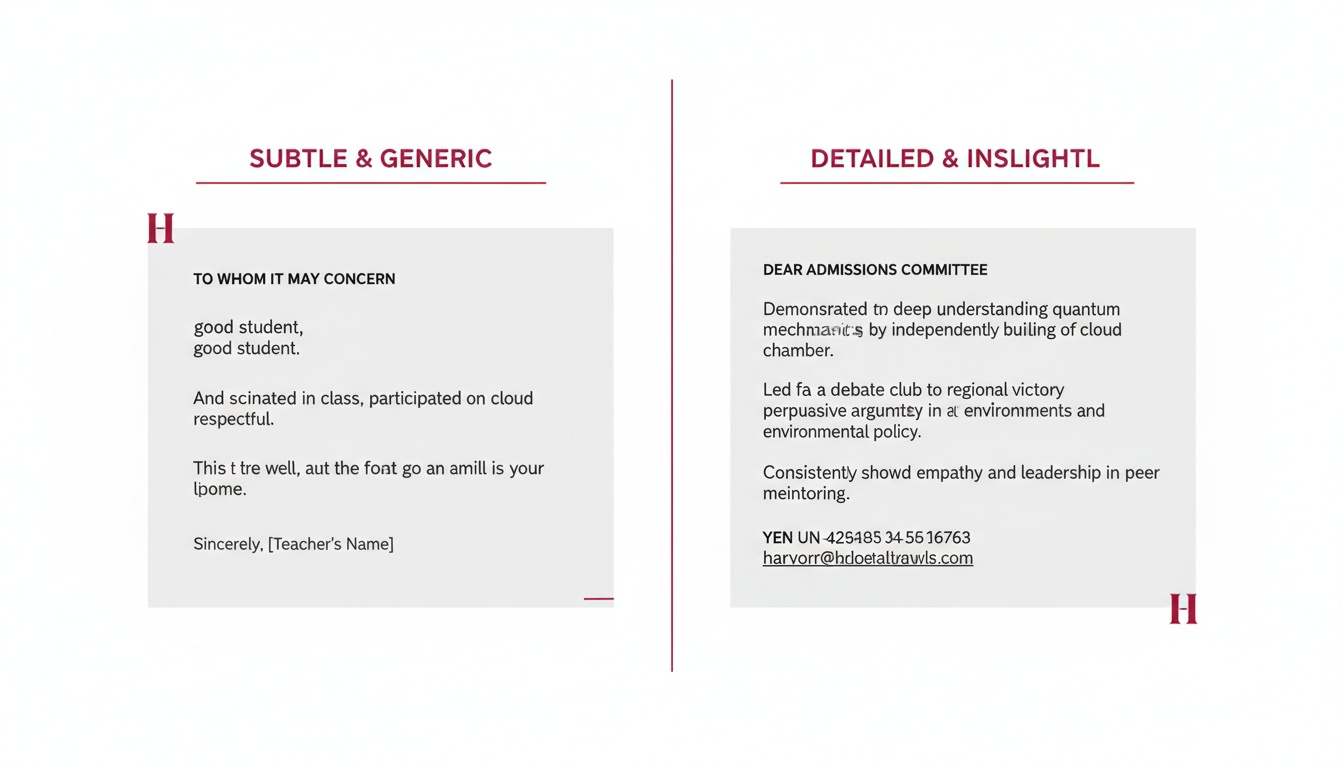
Two teacher recommendation forms are required, from teachers in two different academic subjects. A strong letter describes how you think, not just what you did. It includes specific examples of intellectual curiosity, problem-solving, or growth — weak letters list grades and achievements; strong letters reveal character and potential.
Junior-year academic teachers are the standard choice. They've seen you under pressure, they know your intellectual habits, and they have a full year of material to draw from.
"She earned an A in AP Chemistry" tells Harvard nothing. "She was the only student who came to office hours not because she was struggling, but because she wanted to argue about the assumptions in the lab design" — that's the letter that gets read twice.
How to Brief Your Recommenders
Brief your recommenders properly. Give them your brag sheet, your draft personal statement, and a specific story or two you hope they'll reference. Don't assume they remember the moment you're thinking of.
Harvard also accepts one optional additional recommendation. Use it only if the person can speak to a dimension of you that no other part of the application addresses. A research supervisor, a coach who watched you lead through a difficult season — those are the right choices. A generic letter from a family friend adds nothing.
The secondary school report is a required form submitted by the school counselor or another school leader. It includes your transcript, a school profile, and a counselor letter. Talk to your counselor early (ideally in September of Grade 12). They can only write what they know.
How Extracurricular Activities Factor Into Harvard's Review
Harvard has no formal extracurricular requirement. But the Common App activities section — 10 slots, 150 characters each — is reviewed carefully as part of the holistic review process.
The spike vs. breadth debate matters here. Harvard tends to reward depth and unusual commitment over a laundry list of clubs. A student who spent three years building a tutoring program in their Richmond neighbourhood is more compelling than a student who held officer titles in six clubs. We've seen this mistake from students with 1580s.
The 10-activity limit means how you prioritize is itself a signal — what you chose to include, and what you left out.
Leadership titles matter less than impact and authenticity. "President" of a club that met twice is not a differentiator. A sustained, specific commitment, even in something unglamorous, is.
Think carefully about ordering. The activities list should lead with what's most central to who you are as a competitive applicant, not what sounds most impressive in the abstract. Your first two or three entries set the frame for how readers interpret everything else.
Arts Supplement and Research Summary
These are listed as optional in the checklist — but "optional" means something specific at Harvard. Submit them only if the work is genuinely strong and adds a dimension your application doesn't otherwise show.
Here's what each looks like in practice:
Arts supplement: Available to students with serious work in music, visual art, film, dance, or theater. Harvard accepts recordings, portfolios, or links depending on the medium. If you've been training at a conservatory level, performing in provincial competitions, or showing work in juried exhibitions, this is worth submitting. If you play piano casually, skip it.
Research summary: A one-page document describing significant independent research. Relevant if you've conducted lab research, published or presented work, or completed a substantial independent project. This is not the place to describe a school science fair project. It's for students with genuine research experience — often through university partnerships or programs like the BC Science Fair at the senior level.
Both are submitted alongside the application, not after.
Application Timeline and Deadlines: Step-by-Step
Summer before Grade 12 (June–August) Draft your Common App personal statement. Identify your two teacher recommenders and ask them before school ends in June. Research Harvard's supplemental prompts when they're released in August.
September–October Finalize your application materials. Take your last SAT or ACT by late October if applying REA. Complete the five short-answer questions. Request your fee waiver if applicable.
November 1 — REA application deadline (student) November 8 — REA materials deadline (counselor and teachers) Mid-December — REA decisions released
January 1 — Regular Decision application deadline (student) January 8 — RD materials deadline (counselor and teachers) February — Midyear school report submitted by counselor Late March — RD decisions released May 1 — Enrollment deadline
July 1 — Final school report and transcript due (enrolled students) Mid-July — IB final results sent Mid-August — A-level results sent
Restrictive Early Action vs. Regular Decision: REA is non-binding — you're not committing to attend if admitted. But it is restrictive: you cannot apply Early Action or Early Decision to other private universities while your Harvard REA application is pending. You can still apply to public universities under their early programs.
Apply REA if Harvard is your clear first choice and your application is genuinely ready by November 1. Don't apply REA just to get an answer sooner if your senior fall grades or October test scores would strengthen your file.
The $85 application fee (as of the 2026 cycle) can be paid online via the Common Application or by check or money order to Harvard College Admissions, 86 Brattle Street, Cambridge, MA 02138. Fee waivers are available if paying $85 would be a real stretch and you plan to apply for financial aid — Harvard accepts all standard Common App and College Board fee waiver types.
International Student Requirements and Considerations
The core Harvard College application requirements are identical for international and domestic students. Same deadlines, same materials, same process.
A few additional considerations apply:
Standardized testing: The SAT and ACT are accepted worldwide. GCSE A-Level students and IB students should have their school send predicted grades for their final year alongside the application. Harvard reviews these in context.
English proficiency: Harvard does not require TOEFL or IELTS. (This surprises a lot of families — it's one of the most common questions we get from students at international schools in Vancouver.) English ability is assessed through the application itself — essays, short answers, and teacher recommendations. If your entire education has been in English, as is the case for most students at BC schools, this isn't an issue.
Transcript translation: Documents not in English must be translated. Work with your school to provide certified translations alongside originals.
Financial aid: According to Harvard's Financial Aid Office, Harvard meets 100% of demonstrated financial need for all admitted students, regardless of citizenship. Its need-blind admissions policy applies to both domestic and international applicants. This changes whether Harvard is even on the table for a lot of families — and it's not widely understood among Vancouver-area families who assume US universities are unaffordable.
International Student Additional Checklist:
- Predicted grades from IB coordinator or A-level school ✓
- Certified transcript translations (if not in English) ✓
- CSS Profile + FAFSA (or international equivalent) for financial aid ✓
- IB final results → sent mid-July after enrollment ✓
- A-level results → sent mid-August after enrollment ✓
Application Fee, Fee Waivers, and Financial Aid
The application fee is $85 (as of the 2026 cycle). Pay online via Common App (credit card) or by mailed check.
Fee waivers are available to applicants for whom the fee presents a genuine hardship, provided they plan to apply for financial aid. Harvard accepts the Common App fee waiver, the College Board fee waiver, and requests made directly through the application. The process takes two to three steps inside the Common App platform (as of 2026) — there's no separate Harvard form.
For financial aid, submit both the CSS Profile and the FAFSA. According to Harvard's Financial Aid Office, aid packages consist entirely of grants and work-study — no loans. Income thresholds and contribution percentages are published on Harvard's net price calculator. Use that tool for a family-specific estimate — general figures shift year to year and are often outdated by the time families find them.
Applying for financial aid does not affect admissions decisions. Harvard's need-blind policy applies to all applicants, domestic and international.
Common Application Mistakes and How to Avoid Them
1. Submitting scores that hurt rather than help. Test-optional is gone. If your SAT is well below the published middle-50% range for admitted students, talk to a counselor about whether to retake before applying. Self-reporting a score at the low end of the distribution is a flag, not a neutral data point.
2. Writing supplemental essays that could apply to any school. Each of Harvard's five short-answer questions is designed to reveal something specific. Generic answers — "I value community and intellectual growth" — waste 150 words. Use the space to be precise.
3. Missing the midyear report window. Your counselor submits the midyear report — not you. Which means it's easy to assume it's handled. Confirm with your counselor in January that it's on their calendar. A missing midyear report creates a gap in your file that Harvard will notice, and you won't know it happened until it's too late.
4. Choosing recommenders based on prestige rather than relationship. The teacher who gave you an A+ but barely knows you will write a weaker letter than the teacher who watched you struggle and grow. Depth of relationship beats subject matter every time.
5. Applying REA without understanding the restriction. Are you genuinely torn between Harvard and a school that offers binding ED? Then REA may cost you a real strategic advantage — not a theoretical one. If you're not certain Harvard is your first choice, Regular Decision keeps your options open.
6. Neglecting the counselor relationship. The school counselor report is one of the few places where someone else vouches for your character and context. A counselor who barely knows you writes a short, generic letter. Start the conversation in September.
Unsure whether to apply REA or need help sequencing your timeline? Our team can walk you through the strategy.
Frequently Asked Questions About Harvard Requirements
The questions below come up in almost every conversation we have with Grade 11 and 12 students — and the answers are often different from what families expect.
Is the SAT required for Harvard in 2026?
Yes. Harvard reinstated its standardized testing requirement for the 2026 cycle. SAT or ACT scores are required for all first-year applicants. Self-reporting is done through your application platform; you only submit official scores through College Board or ACT if you enroll. There is no score submission deadline for applicants — only for enrolled students.
What GPA do you need to get into Harvard?
There's no official requirement. In practice, admitted students typically carry strong unweighted GPAs with rigorous course loads. Harvard's holistic review means a slightly lower GPA in challenging courses can outperform a higher GPA in less demanding ones. Rigor relative to your school's offerings is the real benchmark.
Can international students apply Restrictive Early Action?
Yes. International students may apply REA under the same terms and restrictions as domestic applicants. The November 1 deadline applies, and the restriction on other private EA/ED applications is the same. The same restriction applies: no Early Action or Early Decision applications to other private universities while the Harvard REA application is pending. Public university early programs remain permitted.
Does Harvard accept the Coalition Application?
Yes. Common App, Coalition, and QuestBridge are all accepted and treated equivalently in the review process. If you're a QuestBridge finalist, the QuestBridge application is worth understanding in detail. Its matching process runs on a different timeline from standard REA and RD deadlines.
How many recommendation letters does Harvard require?
Two teacher recommendations from teachers in different academic subjects, plus the school counselor report (which includes a counselor letter). The two required teacher letters should come from teachers in different academic subjects. One optional additional letter is permitted — use it only if it adds a genuinely new dimension to your application.
Is financial aid available for international students?
Yes. According to Harvard's Financial Aid Office, Harvard's need-blind admissions policy applies to all applicants regardless of citizenship. Harvard meets 100% of demonstrated financial need for every admitted student who enrolls, including international students. Aid packages consist entirely of grants and work-study — no loans. Use Harvard's net price calculator for a family-specific estimate.
Key Takeaways
- Harvard requires SAT or ACT scores in the 2026 cycle — self-report at application, submit official scores only if you enroll
- The five supplemental short-answer questions (150 words each) are where most competitive applicants differentiate themselves
- REA deadline is November 1 for students; counselors and teachers get until November 8
- The midyear report matters — senior fall grades are reviewed before Regular Decision outcomes
- Harvard's need-blind financial aid policy covers international students; consult Harvard's net price calculator for family-specific estimates
- Homeschooled applicants follow the same process as all other applicants
- Course rigor relative to your school's offerings matters as much as the GPA number itself
- The Common App activities section (10 slots) rewards depth and sustained commitment over breadth
Ready to build a personalized application strategy around your actual profile? Talk to a Vancouver-based admissions consultant — we work with students across Vancouver, Richmond, Burnaby, and the North Shore to develop plans that reflect who you are, not a generic checklist.
For a broader look at Harvard admissions strategy, read our complete Harvard admissions guide for 2026. If you're working on your Common App activities section, our guides on ordering your extracurriculars and filling out the activities list cover that in detail. And if you're invited to interview, our alumni interview prep guide walks through exactly what to expect.