Digital SAT Math 1580: Your Complete Scoring Guide (2026)
Scoring 1580 on the digital SAT math section isn't about being a math genius. It's about eliminating the specific mistakes that cost near-perfect students 20–40 points — and those mistakes are surprisingly predictable. The student who finally hit 1580 after three attempts didn't suddenly get smarter between test two and test three. She stopped making the same four mistakes — and two of them were on questions she knew how to solve. That's the pattern I see repeatedly: students who plateau near 1500 aren't failing on hard questions. They're dropping points on problems they've already mastered.

What Does a 1580 Digital SAT Score Actually Mean?
A 1580 composite puts you at the 99th percentile nationally. If you're applying to schools where test scores still matter, that's the number that takes testing off the table entirely. According to College Board's current concordance tables, a 1580 SAT maps to an ACT 36 — the highest score that test offers.
For college admissions context: at every Ivy League school, MIT, and Caltech, a 1580 sits at or above their 75th percentile for admitted students. That's not a guarantee of admission, obviously, but it removes standardized testing as a liability entirely. (BC students applying to US schools are competing nationally — that 99th percentile benchmark matters more than it might seem from inside a Vancouver classroom.)
Score percentile: 99th nationally ACT equivalent: 36 (per College Board's current concordance tables) Accuracy required: 95%+ — roughly 1–2 missed questions across all 44
To hit 1580, you're typically looking at a math sub-score of 780–800 paired with a Reading/Writing score in the same range. Per College Board's official concordance data, an SAT Math score around 790 corresponds to a perfect 36 on the ACT Math section — that's the benchmark you're chasing.
The margin for error is tighter than most students expect: you can miss roughly 1–2 questions across all 44 math questions and still reach 780+. Maybe three, depending on which ones. That's a 95%+ accuracy requirement, based on College Board's official scoring tables.
Students starting at 1400+ can realistically reach 1580 in 12–16 weeks with structured test preparation. Starting below 1350, you're looking at a longer runway — or a more modest initial goal. See realistic SAT score improvement timelines for baseline-specific estimates.
How the Digital SAT Math Section Works (And Why Module 1 Determines Your Score Ceiling)
The math section is two modules, 22 questions each, 35 minutes per module. Total: 44 questions, 70 minutes.
Module 1 performance determines whether you're routed to the hard module — the only path to 1580. Missing too many questions in M1 locks you into the easy Module 2, capping your score well below your target.
What Actually Changed From the Paper SAT
The removal of the no-calculator section is the biggest structural change for students who prepped on paper SAT materials. On the old format, roughly half the math questions required mental arithmetic or written calculation — Desmos wasn't available. Now it's always available, which sounds like an advantage but creates a new trap.
Students who default to graphing everything slow themselves down on problems that take 15 seconds algebraically. Paper SAT prep materials are still usable for concept practice, but any timing or pacing advice from pre-2023 sources is outdated.
Discard it.
The digital format gives you an on-screen Desmos graphing calculator for every single math question — that calculator/no-calculator split no longer exists. Annotation tools let you mark up diagrams directly, which means you can label angles and sides on-screen instead of reaching for scratch paper. The interface also has a built-in notepad for written work.
Question formats are either four-option multiple choice or student-produced responses (grid-ins, where you type your answer directly). Grid-ins can't be guessed — which means no time wasted second-guessing multiple-choice options. You solve it or you flag it.
Why Module 1 Is the Most Important 35 Minutes
I had a student last spring — scoring 1510 consistently in practice — who went into his real test treating Module 1 as a formality. He rushed through three early algebra questions, made two sign errors, and got routed to the easy module. His score came back 1460. The hard module wasn't even available to him.
Every question in M1 carries the same weight toward your routing decision — the "easy" ones aren't safe to rush through. Treat Module 1 like a high-stakes performance, not a warm-up act.
The hard module is the only ceiling that matters.
The Four Math Domains You Must Master for 1580
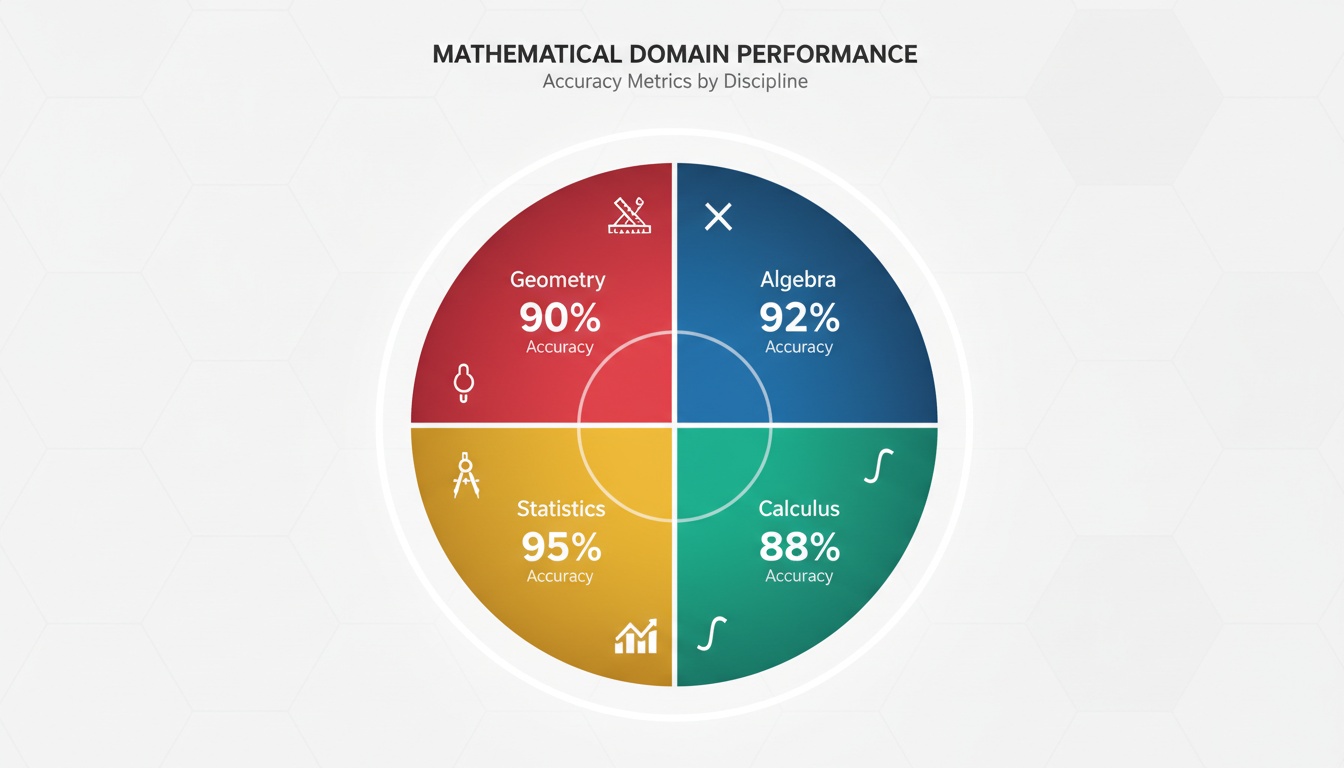
College Board divides digital SAT math into four tested domains. Students targeting a 1580 score cannot afford a weak area in any of them — the hard module will find your gaps.
Algebra
Algebra makes up roughly 35% of questions — the largest single domain. Linear equations, systems of equations, linear inequalities, and word-problem translation all live here.
Most students feel comfortable with algebra. That confidence is exactly why careless errors here are so damaging. A misread sign or solving for the wrong variable costs you a question you should have gotten right — on a test where you can only afford to miss two or three total.
Key skill: translating word problems into equations without introducing errors. The math is rarely the hard part. The setup is.
Advanced Math
Advanced math is the second-largest domain at roughly 35% of questions. Quadratics, polynomials, exponential functions, function notation, and rational expressions all appear here — and the hard module leans heavily on this domain for its most difficult questions.
This is where most students lose points at the 1500+ level. The culprits include: factoring under time pressure, interpreting function behavior from graphs, and handling rational expressions with variable denominators — all high-difficulty question types that appear regularly in the hard module.
Master completing the square — not just the formula, but why it works. Students who understand the reasoning solve related problems faster, including problems that don't look like completing-the-square questions until you're halfway through them.
Problem-Solving and Data Analysis
At roughly 15% of questions, this domain gets underestimated. Ratios, percentages, unit conversion, statistics, probability, and data interpretation all fall here.
Students miss these questions and feel confused — they often seem more "readable" than algebra problems, so errors feel like carelessness rather than knowledge gaps. In fact, they usually are. Reading a table too quickly, misidentifying what a question is actually asking, or confusing mean with median under time pressure are all fixable with deliberate practice.
Practice data analysis questions deliberately.
Not as an afterthought.
Geometry and Trigonometry
Geometry and trigonometry represents roughly 15% of questions, but the difficulty ceiling on the hard module is high. Area, volume, coordinate geometry, right triangles, SOH-CAH-TOA, and circle theorems all appear.
One student I worked with last fall — strong at algebra, completely ignored geometry — lost 4 questions in that domain alone and finished at 1540. Took us two weeks to fix what should have been obvious from her diagnostic. A reference sheet is provided, so you don't need to memorize every formula. What you do need is fluency in applying those formulas quickly, especially for multi-step problems where the formula is just the starting point.
Visualizing diagrams without a physical pencil takes practice. Use the annotation tools.
Your 12–16 Week SAT Study Plan to Reach 1580
Break your prep into three phases. Phase 1 (Weeks 1–3): diagnostic testing and domain identification. Phase 2 (Weeks 4–10): targeted domain practice and timed module simulations. Phase 3 (Weeks 11–16): full test simulations and hard-module error analysis. Each phase has a specific goal — not just "study more."
Phase 1 — Diagnostic and Foundation (Weeks 1–3)
Start with a full official Digital SAT practice test through the College Board Bluebook app. Nothing else gives you authentic adaptive testing — third-party tests approximate the format but can't replicate the actual algorithm.
Your score report will show domain-level breakdowns. Identify your weakest domain before doing anything else. Why? Because students who skip this step spend weeks practicing their strengths.
Target baseline: 1400+. Below 1350? This timeline is aggressive — extend it or adjust your goal.
If your diagnostic comes in below 1350, 12–16 weeks to 1580 is a stretch. Adjust your expectations or extend your timeline before you commit to a plan built around the wrong endpoint.
Phase 2 — Targeted Domain Practice (Weeks 4–10)
Rotate through all four domains with 30–40 focused practice questions per session. By Week 6, introduce timed module simulations: 22 questions, 35 minutes, no interruptions.
Start your error log now. Here's how it works: every missed question gets categorized by domain, question type, and mistake type — conceptual (you didn't know how to solve it) or careless (you knew but made an execution error). These require different fixes.
The weekly target: reduce your error rate in your weakest domain by roughly 20% every two weeks. Vague goals like "get better at algebra" don't move the needle.
Phase 3 — Full Test Simulation and Refinement (Weeks 11–16)
Two to three full timed practice tests per week, using Bluebook and Khan Academy — the only free resource with direct College Board data integration. Focus your error analysis on hard-module question types specifically.
Refine your pacing: aim to finish each module with 3–5 minutes remaining to review flagged questions. Students who rush the last three questions to "finish on time" make more errors than students who flag and return.
Score improvement at this stage is incremental. Going from 1520 to 1560 might take three weeks of targeted work on two specific question types. That's normal — and it's where the error log earns its keep.
Calculator Strategies That Save Time — And When NOT to Use Desmos
Most test preparation advice tells you to use Desmos as much as possible. My actual advice to students targeting 1580: Desmos is a trap if you over-rely on it. Not because it's bad — it's genuinely powerful — but because it slows you down on problems that algebraic reasoning solves in 20 seconds.
Students who score 1580 know when to use Desmos and when to put it down.
High-Value Desmos Techniques for 1580 Scorers
-
Graph intersection points for systems of equations — Systems that would take 90 seconds algebraically resolve in under 20 seconds when you graph both lines and read the intersection. This is the highest-value technique.
-
Use the slider trick for function problems — Honestly, this is the one I wish I'd known earlier. It turns a 3-minute algebraic slog into a 20-second visual check. If a question asks which value of k makes a function have no real solutions, graph it with a slider and watch.
-
Check quadratic roots by graphing — Faster than factoring when the quadratic doesn't factor cleanly. Graph it, read the x-intercepts.
-
Run regression for data analysis questions — Faster than manual calculation for line-of-best-fit problems. An underused strategy at this level.
Time Management: The 1-Minute Rule and Flagging Protocol
Average time per question across 44 questions works out to roughly 95 seconds. But hard questions legitimately need 2–3 minutes. That means easy questions need to go faster than 95 seconds to create that buffer.
The 1-minute rule: if you have no clear path forward after 60 seconds, flag the question and move on. Return with remaining time. There's no penalty for wrong answers, so never leave blanks — but don't burn 4 minutes on one question mid-module either.
Pacing target: complete questions 1–18 in roughly 28 minutes, leaving 7 minutes for flagged review. This isn't rigid — it's a checkpoint, not a rule. Individual question types have their own benchmarks: a linear equation word problem should take under 60 seconds; a rational expression problem can reasonably take 90–120 seconds.
What Mistakes Block Students From Scoring 1580?
The five mistakes below account for the majority of points lost at the 1500+ level. None of them are about not knowing the math.
-
Careless arithmetic errors on "easy" questions — This is the single biggest score killer at this level. Students rush through low-difficulty problems to save time for hard ones, then make sign errors or misread the question. Not difficult questions — easy ones.
-
Misreading the question — Distinct from not knowing the answer. "Which of the following is NOT true" questions catch students who skim. Read every word.
-
Underperforming on Module 1 due to overconfidence — More common than you'd think. Students who've been scoring 1500+ in practice sometimes treat M1 as a formality — then get routed to the easy module and wonder why their score dropped.
-
Neglecting geometry and trigonometry — At 1580, every domain must be near-perfect. A 70% accuracy rate on geometry questions — which feels fine on a normal test — costs you 3–4 questions in that domain alone.
-
Skipping the error log — The study habit that separates students who plateau from students who keep improving. Practicing without analysis is just rehearsing your mistakes.
The Spiral That Kills Hard-Module Scores
High scorers in the hard module often hit a question they can't solve in the first five problems. They stare at it for two minutes and mentally unravel. The anxiety spiral kicks in — "if I can't solve this one, what else am I missing?" — and suddenly they're making errors on questions they'd normally get right.
Flag it immediately. Don't stare. One hard question doesn't change your score if you get the next 17 right.
The mindset reframe that actually works: the hard module is supposed to have questions you can't solve. That's how the adaptive algorithm works. Seeing a question that stumps you isn't a sign you're failing — it's a sign you're in the right module. Students who internalize this perform noticeably better on test day than students who treat every stumped moment as a crisis.
Practice this deliberately during Phase 3 simulations. When you hit a question that stumps you, flag it within 60 seconds and move on.
Make it a reflex, not a decision.
Practice Resources Ranked for 1580-Level Preparation
At the 1580 level, prioritize official College Board resources (Bluebook app, Khan Academy) over third-party alternatives. Supplemental resources like College Panda and 1600.io are worth adding for hard-module depth. Avoid third-party adaptive tests with unverified algorithms — they can give false confidence or false concern.
Tier 1 — Official Resources (Highest Validity)
The College Board Bluebook app is the only source of authentic adaptive Digital SAT tests. Use it for all full practice tests — the adaptive algorithm in third-party tests is unverified and may not accurately route you to the hard module.
Khan Academy SAT prep is free and directly integrated with College Board data. For students who've linked their College Board account, Khan Academy surfaces practice questions based on actual weak areas from official tests. That makes it genuinely useful for targeted domain work, not just general drilling.
Tier 2 — Supplemental Resources
College Panda Math Workbook — One of the stronger supplemental resources for advanced math and algebra depth. Still, it's not officially affiliated with College Board. The question quality and explanations are consistently strong for hard-module preparation.
Art of Problem Solving — Worth considering for students who need competition-level math fluency, particularly for the hardest 3–4 questions on the hard module. Those questions occasionally require reasoning that goes beyond standard SAT math strategies, and AoPS builds exactly that kind of thinking.
1600.io — Worth evaluating if you learn better from worked examples than from drilling. The Desmos-integrated solutions are genuinely useful for visual learners — I've seen students improve their geometry accuracy specifically after working through those. The course covers every digital SAT math topic with over 1,200 example and practice problems, interactive annotated Desmos solution graphs, and pop-up video explanations. A free preview is available without a credit card, which makes it easy to evaluate before committing.
Tier 3 — Use With Caution
Third-party "Digital SAT" practice tests with unverified adaptive algorithms can give you false confidence or false concern — neither is useful. Generic math apps not calibrated to SAT question style build math skills generally but don't translate reliably to score improvement on this specific test.
The 12–16 week timeline above assumes you're working independently. If you're a Vancouver student at York House, Crofton House, St. George's, Sentinel, or U Hill with a specific US application deadline, that timeline gets compressed fast. Book a free SAT prep consultation to map out what's realistic for your actual test date.
Key Takeaways
- Module 1 is your score ceiling — treat it like a high-stakes performance, not a warm-up. Every question carries equal weight toward your routing decision.
- Desmos discipline separates 1500 scorers from 1580 scorers — knowing when to put the calculator down saves more time than knowing how to use it.
- The error log isn't optional — categorizing mistakes by domain and type (conceptual vs. careless) is what drives actual score improvement. Without it, you're just rehearsing.
- Flag hard-module stumpers within 60 seconds and move on — the anxiety spiral kills more scores than the difficult questions themselves. Make flagging a reflex.
Want to understand what a perfect SAT score means for college admissions, or need realistic SAT score improvement timelines for your specific baseline? Both are worth reading before you finalize your prep plan.
College Board Bluebook app Khan Academy SAT prep Official SAT-ACT concordance tables