Common App Activities Ordering: The Complete 2026 Guide
The Common App activities section gets limited attention at a selective school — often as little as a minute or two. Most students spend less than 10 minutes deciding the order.
Yes, it matters — and the gap between students who know this and students who don't is real. Most students treat Common App activities ordering like an afterthought — a résumé dump with no strategy. That's a mistake that costs them, because the sequence you choose tells admissions officers who you are before they read a single word of your essay.
For the 2025–2026 application cycle, the Common App activity section format remains unchanged: 10 slots, 150-character descriptions, 50-character position/organization fields. The strategic principles here apply directly.
By the end of this guide, you'll have a ranked list of your student's activities and a clear slot assignment for each one.

Why Activity Order Changes How Admissions Officers Read Your Entire File
Slots 1–3 receive the most attention; slots 4–7 get a quicker scan; slots 8–10 are often background noise. Application readers move quickly through the activities section, and the sequence you choose shapes how they interpret your entire extracurricular profile.
Most students default to listing activities the way they'd write a timeline — oldest first or busiest first. Neither approach is optimal.
You have complete control over how admissions officers interpret your extracurricular profile, and most students waste this advantage entirely.
Application readers won't always say this out loud, but the activities section gets scanned, not read line-by-line. An AO reviewing files at a selective university might have dozens of applications to get through in a single afternoon. Your extracurricular list is one piece of a much larger puzzle they're assembling quickly.
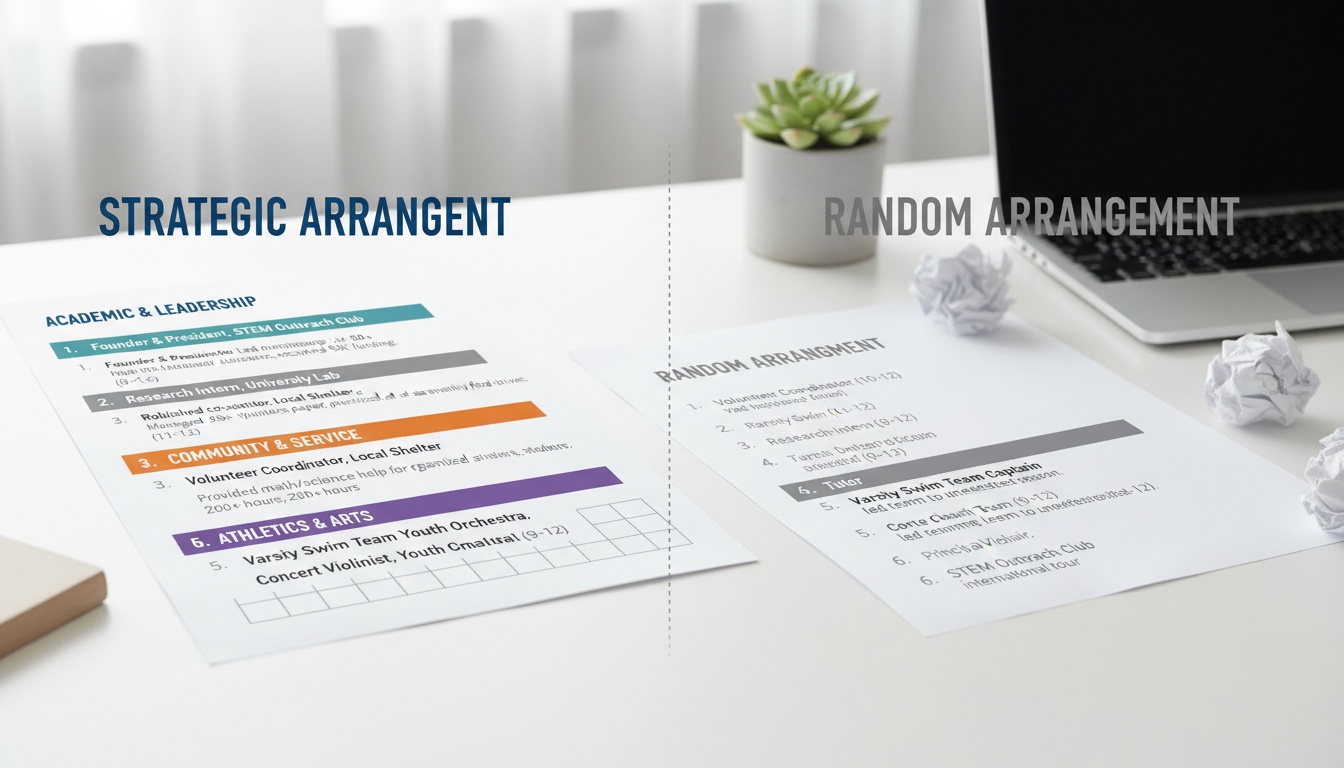
The core principle is simple. List activities by importance and impact, not by when they happened or how many hours per week they consumed. A student who spent three years founding a peer tutoring network at Burnaby North should lead with that — not with the grade 9 volleyball team they joined and quietly quit.
The Quick Scan: How Admissions Officers Actually Prioritize Your Activities
The reading pattern is top-heavy. Slots 1 through 3 tend to receive the most genuine attention. Slots 4 through 7 typically get a quicker scan. Slots 8 through 10? Often background noise — unless something surprising appears there. The exact breakdown varies by reader and institution, but the top-heavy pattern is widely reported by former admissions officers.
Sara Harberson, former associate dean of admissions at the University of Pennsylvania and former dean of admissions at Franklin & Marshall College, wrote a book called SOUNDBITE about exactly this dynamic. Her argument is that the activities section functions as a compressed signal of who you are. Your slot 1 activity sets the interpretive frame for everything that follows.
Think of it this way: if your #1 activity is a three-year research internship at UBC, every subsequent activity gets read through a "serious STEM student" lens. That's the narrative arc principle — the idea that your slot 1 activity sets an interpretive lens that colors how every subsequent activity is read — working in your favour.
What Application Readers Are Actually Looking For
Lead with your single most meaningful activity — this sets the interpretive frame for everything that follows and prevents your application from reading as scattered or unfocused. Then arrange the remaining slots to reinforce a coherent story about who your student is.
What application readers want to see:
- Evidence that the student actually cares about something, not just that they showed up
- Leadership and depth over breadth
- A through-line that makes the student feel intentional rather than scattered
Five well-described activities outperform ten thin entries. That's not a platitude — it's the difference between a list that builds a case and one that dilutes it.
Not sure how to rank your student's activities? Book a free activity ordering consultation — we'll score each one and assign slots.
5 Ordering Strategies by Student Profile: Find Your Archetype and Rank Accordingly
One-size-fits-all advice fails students. A recruited rower at St. George's has a completely different activity prioritization problem than a York House student who's been leading a climate advocacy club since grade 10. Here are five student archetypes with tailored ordering logic — including the spike vs. well-rounded distinction that admissions conversations often hinge on.
Strategy 1: The Recruited Athlete
Sport goes to slot 1. End of discussion.
If a university's coaching staff is already tracking your student — and at schools like UBC or McGill, recruitment conversations can begin earlier than most families realize — the athletic activity is the anchor of the entire application. Everything else exists to prove there's a complete person behind the sport.
Use the remaining slots to show leadership and community dimension: volunteer work, academic competitions, anything that demonstrates the AO is reading about a full human being, not just an athletic result.
Don't bury a captaincy or MVP recognition in slot 4 because "it didn't start until grade 11." Recency doesn't disqualify an activity from the top slot.
Strategy 2: The STEM-Focused Student
Lead with the most prestigious STEM activity: a research publication, a national olympiad placement, a competition win, or a genuine internship (not just a shadow). Follow with any leadership roles that show the student applying STEM to real problems.
A student who placed in the top 50 at the Canadian Computing Competition and also runs a coding club at their school should lead with the CCC result — then use the club to show they teach and lead, not just compete. The activity type dropdown matters here too: "Academic" and "Research" categories signal seriousness in a way that "Club/Organization" alone doesn't.
Strategy 3: The Arts-Focused Student
Lead with the highest-recognition arts achievement. Principal role in a production, first chair in a regional orchestra, a published piece, an award at a juried exhibition. Secondary slots should show community impact or creative range.
We've seen students at Crofton House bury a lead role in a mainstage production behind two clubs where they held no position. The reorder takes five minutes and completely changes the first impression. Five minutes.
Strategy 4: The Community/Social Justice-Focused Student
Lead with the initiative where your student had the most ownership. Founded, led, or meaningfully grew something. Avoid leading with participation-only roles — showing up is not the same as driving change, and application readers know the difference.
If your student started a food security initiative in Richmond that expanded to three schools, that goes first. The club they joined as a general member in grade 9 goes to slot 8.
Strategy 5: The "Well-Rounded" Student With No Single Spike
Honestly, this is the hardest profile to order well — and the one where bad ordering does the most damage. A student with genuine range can look scattered or unfocused if the first three slots don't establish a through-line.
It's just how fast pattern recognition works when a reader is moving quickly through a file.
The strategy is to identify a unifying theme — even a loose one — and arrange activities to tell that story coherently.
Finding the Through-Line When You Have No Single Spike
Slots 1 through 3 establish identity. Slots 4 through 7 add dimension. Slots 8 through 10 show breadth without diluting the core narrative.
A student interested in public policy might lead with their Model UN leadership, follow with a community newspaper column, then add tutoring and a part-time job. That sequence tells a story about someone who thinks about civic problems and acts on them in multiple registers — not just someone who joined things. The narrative arc isn't about having one spike. It's about making the pieces feel intentional.
Should Work Experience Lead Your List?
Only if it demonstrates genuine impact, leadership, or meaningful commitment. A student who managed staff and revenue at a family business has a slot 1 activity. A one-summer retail job belongs in slots 7–10. The test is the same for every activity: does it show intentionality and growth?
Paid work is a legitimate activity category in the Common App — and for many students, it's genuinely more impressive than any club they've joined. A student who managed a family restaurant in Richmond through the pandemic, handled scheduling for a dozen staff, and grew the catering side of the business has a slot 1 activity. Don't let anyone tell you otherwise.
To maximize impact when work experience leads, the 50-character position/organization field and the 150-character description field become critical. Be specific. "Shift supervisor, 12 staff, $8K monthly revenue managed" beats "worked at family business" every time.
Should You Reorder for Different Schools?
No. The Common App sends the same activities list to every school. Order strategically based on your student's core identity, not on individual school preferences. If your student is genuinely applying to programs with different expectations, consider whether a single ordering works across both contexts.
That said, this reality should influence how you order in the first place. If your student is applying to both engineering programs and liberal arts colleges, the ordering strategy needs to work across both contexts. Lead with the activity that best represents your student's identity — not the one that's most "impressive" for one specific school type.
A student who is genuinely a STEM researcher and a theatre performer needs to make a call about which identity leads, then use the description fields to show range.
Some students maintain two separate Common App accounts for dramatically different application pools — one STEM-focused, one arts-focused. But this is rare, logistically complex, and only worth considering if the student is genuinely applying to programs with completely different expectations.
5 Ordering Mistakes That Cost Students Admission
Mistake 1: Defaulting to chronological order. Listing activities by grade year is the most common error we see. Grade 9 activities are not inherently less important than grade 12 ones — but they're also not automatically more foundational.
Mistake 2: Confusing time commitment with importance. The activity that consumed the most hours per week is not necessarily the most meaningful one. A student who spent 15 hours a week at a part-time job and 2 hours a week leading a school newspaper might genuinely have a stronger case for leading with the newspaper, if that's where their voice and leadership lived.
Mistake 3: Burying leadership roles late in the list. We've reviewed applications where a student's most impressive leadership role sat at slot 7 because the activity started junior year. Recency doesn't disqualify anything. If it's your strongest activity, it goes first.
Mistake 4: Listing a prestigious-sounding activity first when the student barely participated. Application readers notice the disconnect between a slot 1 placement and an activity description showing 2 hours per week with no leadership and no growth. We've seen this exact pattern — a student lists a prestigious research program at slot 1, the description says 2 hrs/week, no output, no role beyond "participant." The mismatch raises questions about authenticity that are hard to recover from. That disconnect actively hurts the application.
Mistake 5: Ignoring how the activities list interacts with the essay. If your personal statement is about an activity — and many are — that activity should appear in slot 1 or 2. Putting your college essay's central activity in slot 6 while something unrelated leads the list creates a jarring disconnect for the reader.
For gaps or less impressive activities: place them in slots 7 through 10 and write honest, forward-framing descriptions. Don't apologize for them. Just don't feature them.
The 7-Step Ranking System: From Activity Audit to Slot Assignment
1. Audit everything. List every activity your student has done, regardless of whether it'll make the final cut. Don't self-edit yet.
2. Score each activity on three dimensions. Rate Impact, Leadership, and Commitment each on a 1–5 scale. Add them up. This isn't a perfect system — a student who founded something with 8 hours a week will outrank a student who showed up to 15 hours of meetings, even if the totals look similar — but it forces honest comparison instead of going with gut feel.
Score each activity on Impact, Leadership, and Commitment (1–5 each). Add the scores. Use the total to assign slots.
| Activity Name | Total Score | Assigned Slot |
|---|---|---|
| Research internship (5+4+4) | 13 | 1 |
| Math team captain (4+5+3) | 12 | 2 |
| NHS member (2+1+2) | 5 | 9 |
3. Identify the anchor activity. The one that best represents who this student is goes to slot 1. If two activities score identically, choose the one that connects most directly to the student's intended major or essay theme.
4. Check narrative coherence. Do slots 1 through 3 tell a consistent story about the student's identity and values? If slot 1 is research, slot 2 is math olympiad, and slot 3 is a science fair win, you've established a clear identity. If slot 3 is a baking club, ask whether it adds dimension or just creates noise.
5. Assign supporting activities to slots 4 through 7. These should add dimension without contradicting the core narrative. Leadership roles that don't fit the "core identity" zone still belong here, not buried in slots 8–10.
6. Place breadth or filler activities in slots 8 through 10. If your student has fewer than ten activities, leave slots blank. Padding with one-time volunteer events to hit the number ten actively weakens the list.
7. Cross-check against essays. Read the personal statement and supplemental essays alongside the ordered activity list. The ordering should reinforce the essay themes, not contradict them — activity selection and essay narrative should feel like two parts of the same argument, not two separate documents that happen to share an applicant's name.
Real Examples: Before and After Activity Ordering
Example 1: The STEM student who buried the lead.
Before: Slot 1 was NHS membership (participation only, 2 hrs/week). Slot 3 was a summer research internship at SFU with a co-authored poster presentation.
After: Research internship moves to slot 1. NHS drops to slot 9. The application reader now sees every subsequent activity through the lens of a student who does real research — which is exactly the right frame for a student applying to engineering programs.
Example 2: The arts student who undersold herself.
Before: Slots 1 and 2 were two clubs where the student held no leadership role. Slot 4 was the lead role in a mainstage musical production at her school.
After: The lead role moves to slot 1. The clubs move to slots 6 and 7. The AO's first impression is now "serious performer" rather than "joiner."
Example 3: The student who padded to reach ten.
A student with 6 strong activities filled slots 7 through 10 with three one-time volunteer events and a brief summer job with no description.
The cleaner version: 6 well-described activities, four blank slots. Admissions officers don't penalize students for having six activities instead of ten. They do notice when the last four entries look like résumé filler.
A Real Outcome Worth Noting
One student we worked with — a grade 12 student from Burnaby — had a co-authored research poster from an SFU summer program sitting at slot 5. Her slot 1 was NHS membership. We reordered in a single session. She was admitted to UBC Science and received a merit scholarship interview at Western.
The reorder didn't do that alone. But it stopped the application reader from spending their first moments thinking "joiner" instead of "researcher" — and that reframe changed how every subsequent activity on her list got interpreted.
Our team has reviewed hundreds of Common App files from students across the Lower Mainland. The ordering conversation is almost always the fastest, highest-return hour we spend with a family.
FAQs: Activity Ordering Questions Answered
Does order matter in the Common App? Yes. The activities section is scanned under time pressure, and slots 1–3 tend to receive the most attention. The sequence you choose shapes how an application reader interprets your entire extracurricular profile. Students who treat ordering as an afterthought are leaving one of the few fully controllable strategic levers unused.
Can I reorder my activities after submitting? No. Once you submit to a school, the order is locked — there's no revision option. Plan the sequence carefully before you hit submit, because you can't adjust it afterward.
Should I list activities by hours per week or by importance? Importance wins. Time commitment hours matter for the description field, but they don't determine slot order.
What if my most meaningful activity only started senior year? Still list it first. Recency doesn't disqualify an activity from slot 1. What matters is impact and meaning, not duration.
Does the Common App require a specific ordering format? No. Students have complete freedom in extracurricular activities ordering. The platform won't flag or penalize any sequence you choose.
Does the activity type dropdown affect how my list is read? It can. Activity categories like "Research" or "Academic" carry different connotations than "Club/Organization" or "Other." If your student's top activity falls into a high-signal category, make sure the dropdown reflects that accurately — don't default to "Other" when a more specific category applies.
Should work experience lead the list? Only if it demonstrates genuine impact, leadership, or meaningful commitment. A student who managed staff and revenue at a family business has a slot 1 activity. A one-summer retail job belongs in slots 7–10. The test is the same as for every other activity.
Does the honors and awards section interact with the activities list? Yes — and students often underuse this connection. If an activity generated a significant award or recognition, that recognition can appear in the honors section while the activity itself leads the activities list. The two sections reinforce each other when they're aligned.
Getting the activity ordering right is genuinely one of the most controllable strategic moves available to students in the Common App process. It costs nothing to reorder — but the difference between a strategically ordered list and a chronological dump can shape how an application reader interprets your entire file.
The students who struggle most aren't the ones with weak activities. They're the ones with strong activities in the wrong order. That's a fixable problem.
If you want a second set of eyes on your student's activity list before they submit, book a free activity ordering consultation with our team. We work with students across the Lower Mainland — from West Van to Richmond — and we've reviewed enough applications to know exactly what moves the needle.
For a deeper look at filling out each field in the activities section, read our complete guide to filling out your Common App activities list. Once the order is set, the description field is where students lose or gain the most ground.
Key Takeaways
- List activities by importance and impact, not chronological order.
- Slots 1–3 tend to get the most attention — readers move quickly through the activities section, and the first three slots set the interpretive frame for everything that follows.
- Your slot 1 activity determines how an admissions officer reads the rest of your file. Choose it as the anchor of your student's narrative.
- Different student profiles require different ordering strategies — the spike vs. well-rounded distinction matters here.
- Use the Impact/Leadership/Commitment scoring table to force honest comparison between activities before assigning slots.
- Paid work experience belongs at slot 1 if it demonstrates genuine leadership and impact. Don't automatically deprioritize it.
- If your student has fewer than 10 activities, leave slots blank. Padding with weak entries actively hurts the list.
- Cross-check the activity order against essay themes before submitting. The two should reinforce each other.
- Once submitted to a school, the order is locked. There's no going back.