AP Courses in BC: The Complete 2026 Student Guide
Each May, thousands of BC secondary school students write AP exams — and a surprising number discover afterward that their score won't earn them a single credit at UBC. Not because they failed. Because they didn't understand how credit policies actually work before they registered.
This guide fixes that. It covers which AP courses BC schools actually offer, how UBC and SFU handle AP transfer credit, what exams cost, and how to pick the right courses without burning out before graduation.
In this guide: Which BC schools offer AP | How UBC and SFU credit AP scores | 2026 exam costs | How to choose without burning out
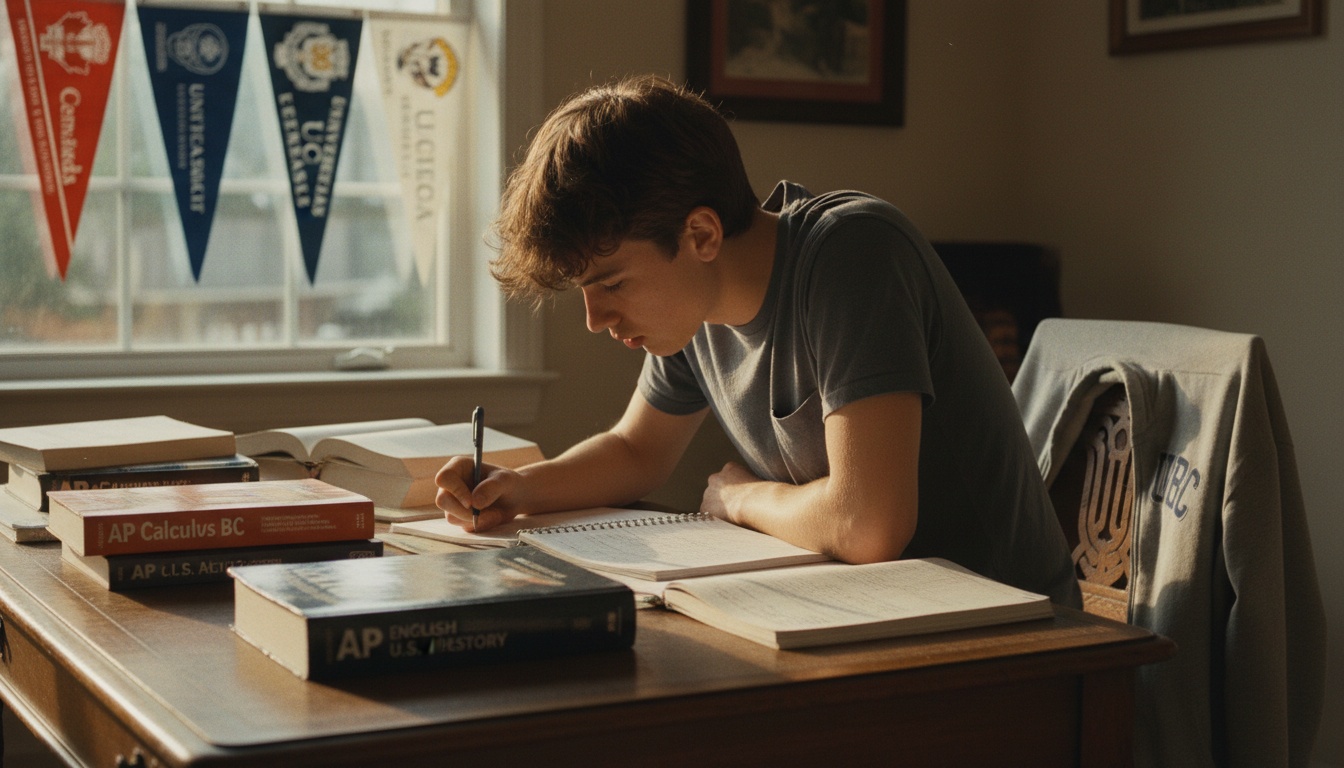
Does BC Have AP Classes? What Every Student Should Know
Yes. More BC high schools offer AP courses than most parents realize — both public and independent schools participate. Schools like York House, St. George's, Crofton House, Sentinel, Burnaby North, and University Hill Secondary all have AP offerings. Availability varies by school and subject; students whose schools don't offer a specific course can often access it through BC's distributed learning system.
Advanced Placement is a program run by the College Board, a US-based non-profit that develops university-level curricula for secondary school students.
You write a standardized exam in May, scored on a scale of 1 to 5. Universities use that score to decide whether to grant transfer credit or let you skip introductory courses.
BC high schools — both public and independent — participate in the AP program. Even some smaller district schools have added AP sections over the past few years, particularly in math and sciences.
Why do BC students choose AP over regular Grade 12 courses? Three reasons come up constantly in our conversations with families: earning university credit before arriving on campus, strengthening applications to competitive programs, and demonstrating academic readiness to US universities that don't always know how to interpret BC's curriculum.
One thing worth clarifying early: AP and IB are not the same program. IB (International Baccalaureate) is a full diploma framework — students commit to the whole package. AP is modular. You pick specific courses, write individual exams, and universities evaluate each score separately.
When does IB make more sense than AP? If your school offers a strong IB program and you want a cohesive, internationally recognized diploma, IB has advantages — particularly for students targeting UK universities. But if you want flexibility to mix subjects, or your school doesn't offer IB, AP is the more practical path. Some students at schools like Magee or West Point Grey Academy do both, stacking AP courses alongside their IB coursework.
Start with the course list — the first mistake most students make is picking the wrong ones.
Complete List of AP Courses Available in BC, Ranked by Difficulty
The College Board currently offers 42 AP subjects (as of the 2025–26 academic year). Not every BC school offers all of them — but the most popular ones appear consistently across Metro Vancouver, the Fraser Valley, and Victoria.
Difficulty breaks down into three tiers, and the differences matter. The tiers below reflect national pass rates, time commitment, and feedback from students we've worked with in Richmond, Coquitlam, and North Vancouver.
AP Course Difficulty Tiers
| Tier | Courses | Notes |
|---|---|---|
| Manageable | AP Psychology, AP Human Geography, AP Environmental Science, AP Microeconomics, AP Macroeconomics | Lower time commitment; strong for Grade 11 starters |
| Challenging | AP Biology, AP Chemistry, AP Statistics, AP English Literature, AP English Language, AP US History, AP World History, AP Computer Science A | Require consistent weekly effort and strong prerequisite knowledge |
| Most Demanding | AP Calculus BC, AP Physics C (Mechanics / E&M), AP Chemistry (combined with heavy courseload), AP Research | High time investment; exam pass rates are lower than the manageable tier |
STEM AP Courses
AP Biology requires completion of Biology 11, with Chemistry 11 strongly recommended as preparation. It's a lot of reading. Expect weekly content loads that rival a first-year university course — students who underestimate this tend to fall behind by February.
AP Chemistry requires Chemistry 11 as a prerequisite. Students who've taken Honours Chemistry 11 at schools like Burnaby North or Sentinel tend to find the transition more manageable than those who haven't.
AP Calculus AB requires Pre-Calculus 11 and concurrent enrollment in Pre-Calculus 12. AP Calculus BC covers additional material (series, parametric equations) and is the version that earns the most credit at UBC Engineering.
AP Physics comes in several versions: Physics 1, Physics 2, and the calculus-based Physics C. Physics C is the version engineering programs prioritize.
AP Computer Science A (Java-based) and AP Computer Science Principles (broader, less coding-intensive) both work well for students at schools with strong CS programs. AP Environmental Science has the lowest recommended preparation bar — any Science 11 qualifies — making it a reasonable entry point for students new to AP.
Humanities, Languages & Arts AP Courses
AP English Literature requires English 11 and is the more analytically demanding of the two English options. AP English Language focuses on rhetoric and argumentation — useful for students heading into law, business, or social sciences.
History options include AP US History (APUSH), AP World History, and AP European History. APUSH is the most commonly offered at BC independent schools, partly because it pairs well with US university applications.
For world languages, BC schools offer AP French Language, AP Spanish Language, AP Mandarin Chinese, and AP Japanese Language. The language exams are difficult — even heritage speakers find the formal writing components demanding.
AP Capstone is a two-year pathway: AP Seminar in Grade 11, AP Research in Grade 12. Students who complete both with scores of 3 or higher on all assessments earn the AP Capstone Diploma. It's not widely offered in BC public schools yet, but several independent schools have added it since 2022.
AP Calculus BC, AP Chemistry, and AP Biology consistently earn course-specific credit — not just elective credit — at both UBC and SFU for science and engineering applicants. More on that below.
What Does the AP Exam Look Like?
AP exams combine multiple-choice and free-response questions (FRQs). The split varies by subject — AP Calculus BC is roughly 50/50, for example. Total exam time ranges from two to three hours. Scores run from 1 to 5, with 3 considered passing by the College Board, though BC universities set higher thresholds for actual credit.
The split varies by subject. AP Calculus BC, for example, is roughly 50% multiple choice and 50% free response, with the FRQ section carrying significant weight.
A score of 1 or 2 earns no credit anywhere. It also doesn't appear on your transcript unless you choose to send it — the College Board lets you withhold scores from specific schools. That's worth knowing before exam day.
The College Board publishes scoring guidelines for past free-response questions through AP Classroom, their official student portal. Working through those FRQs under timed conditions is the single most useful exam prep activity available — more on that in the study strategy section.
Understanding the exam format is one thing; knowing how universities evaluate those scores is another.
Does BC Take AP Credits? How BC Universities Accept AP Scores
Yes, BC universities accept AP scores, but policies vary significantly by institution and faculty. UBC generally requires a score of 4 or higher for course-specific credit; SFU accepts 3 or 4 depending on the subject. A score of 3 might feel like a pass — it won't exempt you from first-year courses at UBC or SFU. Always check the faculty-level AP credit chart before assuming your score counts.
Policies differ by institution, faculty, and the specific score you earned. A 3 might get you elective credit at one school and nothing at another.
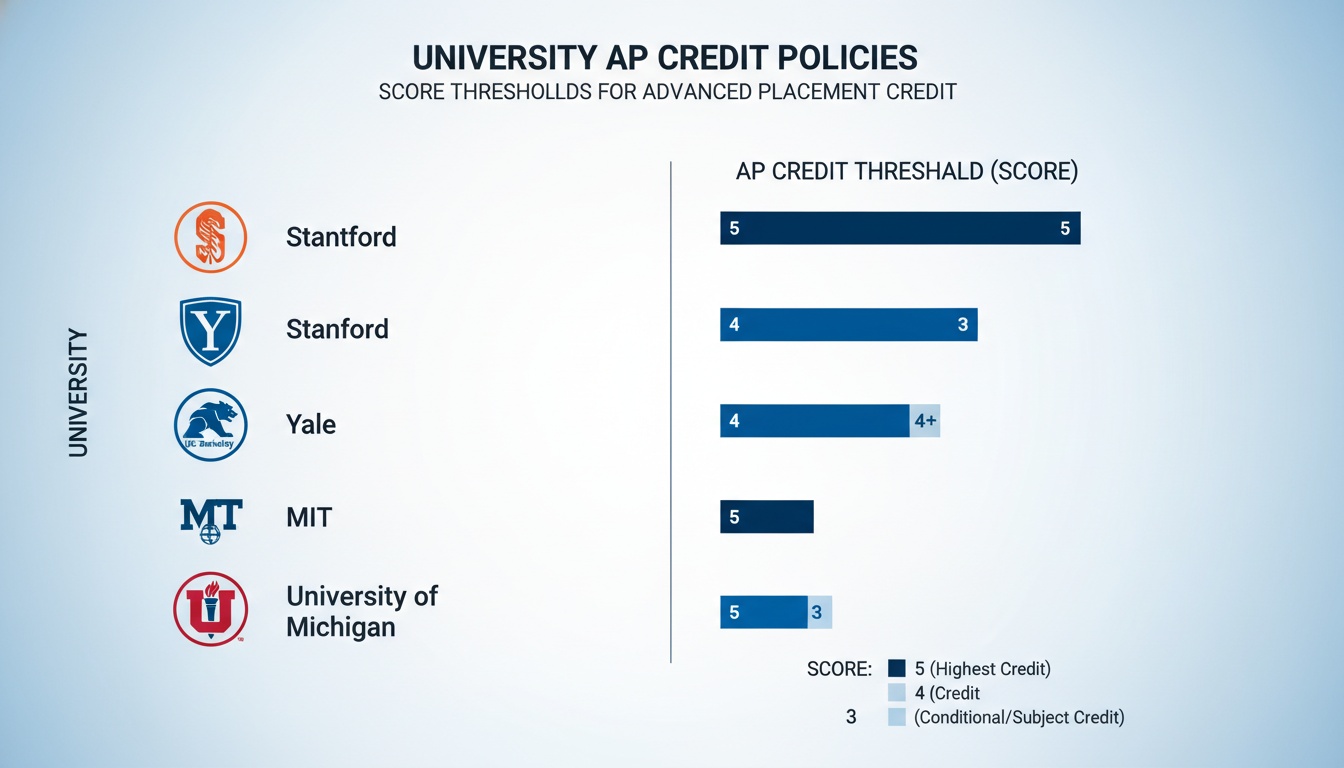
AP Credit Thresholds at BC Universities
| University | Minimum Score | Credit Type | Strictest Faculties |
|---|---|---|---|
| UBC | 4 (most subjects) | Course-specific or elective | Engineering, Sciences |
| SFU | 3 or 4 (varies by course) | Course-specific or elective | Computing Science |
| UVic | 4 (most subjects) | Course-specific | Engineering |
| TWU | 3 | Elective credit | Varies |
(Policies current as of the 2025–26 academic year — verify at calendar.ubc.ca and transfercredit.sfu.ca before making enrollment decisions.)
UBC's Faculty of Science awards credit for AP Biology (score of 4+) as equivalent to BIOL 111/112. AP Calculus BC with a 5 can exempt you from MATH 100 and 101 — two first-year courses cleared before you arrive on campus.
Most families mix up two things that aren't the same. "Advanced standing" means you skip a course. "Transfer credit" means the course counts toward your degree requirements. Sometimes you get both. Sometimes only one. Always check the specific faculty's AP credit chart on the university's website — not a third-party summary.
Some universities also require a placement test even when you hold AP credit, particularly in mathematics and writing. Check faculty-specific policies before assuming your score automatically places you into second-year courses.
One thing AP credit does NOT do: replace BC Ministry of Education graduation requirements. AP Calculus BC does not count as your Math 12 credit for the Dogwood Certificate. You still need to complete the BC curriculum requirement separately. We've seen students surprised by this in Grade 12 — don't be one of them.
For students also targeting US universities — which applies to a lot of families in West Vancouver and Richmond — AP scores are universally understood. A strong score on AP Calculus BC carries the same weight at MIT as it does at UBC. If you're building your US application, strong AP scores give your application a concrete academic signal that goes beyond grades alone. Our guide on recommendation letters for US college applications covers the other pieces of that puzzle.
US schools like Boston College award advanced placement for scores of 4 or 5, and in some cases a 3. Students who accumulate enough AP credits there may qualify for advanced standing and graduate in three years — a real financial consideration worth calculating.
Ontario students pay similar College Board exam fees and face comparable credit policies at their provincial universities. Quebec is different. The CEGEP system means most Quebec students don't engage with AP at all, since CEGEP already functions as a bridge between secondary school and university. BC students don't have that equivalent, which is part of why AP carries more strategic weight here.
Now that you know what a score is worth, here's how the registration and payment process actually works.
AP Exam Timeline, Costs, and Registration in British Columbia
The AP calendar runs on a fixed annual cycle. The timeline for BC students in 2026:
September–October: Students enroll in AP courses at their school. Confirm your school has a designated AP coordinator — all registration goes through them, not directly through the College Board.
November (typically by November 15): Exam registration deadline at most BC schools. Miss this window and you may not be able to write in May. Some schools have earlier internal deadlines — ask your coordinator in September, not November.
First two weeks of May: AP exam window. The 2026 exam schedule is published on the College Board's website; dates are fixed internationally.
July: Scores release. You send your AP score report to universities directly through the College Board's portal — scores don't transfer automatically.
Costs: The College Board's standard exam fee for 2026 is approximately USD $98 per exam (as of the 2025–26 academic year — check apstudents.collegeboard.org for the most current fee schedule). The College Board held this fee flat from 2025 to 2026, though the CAD equivalent has shifted with exchange rates — budget CAD $140 to be safe. Some BC schools add an administration fee on top of that. For students at distributed learning (DL) schools or independent providers, the fee structure may differ; some programs bundle course delivery costs with the exam fee, which can bring the total substantially higher.
Fee reductions are available for students who qualify based on financial need. Talk to your school's AP coordinator or counsellor — the process is handled at the school level.
Homeschool students and independent learners can register for AP exams through a local school that serves as a testing site. The College Board maintains a list of schools willing to host outside students. This path takes more planning, so start the conversation no later than September.
For context on where AP fits within your broader standardized testing timeline, our PSAT vs SAT guide covers how these tests interact with AP preparation.
Online, Blended, and In-Person AP Courses in BC
Not every BC school offers every AP course.
A student at a smaller district school in Coquitlam or Langley might have access to AP Calculus and AP English but nothing else. Rural students face even more limited options. This is where online and blended delivery models become useful.
BC's distributed learning (DL) system allows students to take courses from schools outside their home district. Schools like SIDES (Surrey Internet Delivered Education School) and SD43 Online (Coquitlam) offer AP courses to students province-wide. If your school doesn't offer AP Chemistry but you want to write that exam, a DL school is often the simplest path.
The three delivery models in practice:
In-person: Most common in Metro Vancouver independent schools and larger public schools. You have a teacher, a classroom, and a structured schedule. For most students, this is the most effective format.
Blended/hybrid: Some schools run AP courses with a mix of in-person sessions and online work. Teacher meetings may happen via Zoom or Google Meet, with asynchronous coursework between sessions.
Fully online: Available through DL schools and some private providers. Works well for self-directed students; harder for those who need accountability. (And honestly, most 16-year-olds need accountability — that's not a criticism, it's just true.)
Can you self-study for AP exams without taking a formal course? Technically, yes. Practically, success rates drop noticeably. The exams — especially AP Chemistry and AP Calculus BC — require the kind of iterative feedback that's hard to replicate alone. Khan Academy offers free AP prep aligned to the College Board's curriculum, and it's a solid resource for foundational review. But it's not a substitute for a structured course with a teacher who knows where students lose marks on free-response questions.
How to Choose AP Courses That Actually Earn Credit
Course selection is where most students make their biggest mistake. Taking too many AP courses at once, or choosing based on what their friends are doing rather than what aligns with their goals — that's how students arrive at May exhausted and underprepared.
Three Questions to Ask Before You Register
Question 1: Which AP courses match your intended major? Pre-med students should prioritize AP Biology and AP Chemistry. Future engineers need AP Calculus BC and AP Physics C. Business-bound students benefit from AP Microeconomics, AP Macroeconomics, and AP Statistics. Humanities students should consider AP English Literature and one history course.
Question 2: What's your realistic time budget? Most BC students take 2–4 AP courses total across Grades 11 and 12. That's the realistic range. Taking five or six is technically possible. But if you're managing BC Grad requirements, extracurriculars, and weekend language school — common for Richmond and Burnaby students — five AP courses will break you before May.
Question 3: Are you sequencing correctly? AP Statistics works best after Pre-Calculus 11, with a strong grade — the 86%+ benchmark cited by some BC providers is realistic. AP Calculus AB requires concurrent Pre-Calculus 12 enrollment. Don't skip recommended preparation and hope the exam goes well.
Recommended sequences by goal:
- Engineering: AP Calculus BC (Gr 12) + AP Physics C (Gr 12), preceded by AP Statistics or AP Computer Science (Gr 11)
- Life Sciences / Pre-Med: AP Biology (Gr 12) + AP Chemistry (Gr 12), with AP Environmental Science as a Gr 11 entry point
- Business: AP Microeconomics (Gr 11) + AP Macroeconomics (Gr 11) + AP Statistics (Gr 12)
- Humanities: AP English Literature (Gr 12) + AP World History or APUSH (Gr 11)
Not sure which sequence fits your situation? Our Vancouver-based consultants help students map AP plans aligned to their specific goals and school offerings.
A B in AP Calculus BC looks better to UBC Engineering than an A in Principles of Math 12. Admissions committees understand the difficulty difference. We've seen students admitted to competitive programs with AP grades that wouldn't have stood out in standard courses — because the course itself signals something.
That said, a failing grade in AP hurts. Don't take AP courses you're not ready for just to impress an admissions committee.
For study strategies: use College Board's free AP Classroom — it has past free-response questions with scoring guidelines, and this is the single most useful resource for exam prep. Work through FRQs under timed conditions starting in February. Don't wait until April.
One student we worked with — call her Maya, Grade 12, Richmond, applying to UBC Science — took AP Calculus BC and AP Biology in the same year. Her parents thought it was too much. She earned a 4 and a 5, respectively, and entered UBC Science with both courses credited. She skipped MATH 100 and BIOL 111/112, which freed up room in first year to take upper-level electives — and potentially graduate a semester ahead of schedule. That's the real outcome: not just credit, but flexibility.
If you're building extracurricular depth alongside AP coursework, the Duke of Edinburgh Award guide is worth reading — it's one credential that reads well on both Canadian and US applications.
AP courses are demanding. Anyone who tells you otherwise hasn't written the Chemistry or Calculus BC exam. But the payoff — university credit, a stronger application, and the confidence that comes from doing genuinely hard academic work — is real for BC students who approach it strategically.
Frequently Asked Questions
Does BC have AP classes?
Yes. BC high schools — both public and independent — offer AP courses through the College Board program. Schools like York House, St. George's, Crofton House, Sentinel, Burnaby North, and University Hill Secondary all have AP offerings. Availability varies by school; students whose schools don't offer a specific course can often access it through BC's distributed learning (DL) system.
Does BC take AP credits?
BC universities accept AP exam scores, but policies vary by institution and faculty. UBC generally requires a score of 4 or higher for course-specific credit; SFU accepts 3 or 4 depending on the subject. Always check the faculty-level AP credit chart — not a general summary — before assuming your score will count toward your degree requirements.
What's the difference between elective credit and course-specific credit?
Elective credit counts toward your total degree credits but doesn't satisfy a specific course requirement. Course-specific credit replaces a named course in your program. For science and engineering students, the distinction matters a great deal — elective credit for AP Chemistry won't exempt you from first-year chemistry at UBC.
Can I take AP courses online in BC?
Yes. BC's distributed learning system allows students to enroll in AP courses through schools like SIDES or SD43 Online, regardless of their home district. This is the most common path for students whose schools don't offer the specific AP course they need.
What happens if I score a 1 or 2?
A score of 1 or 2 earns no credit at any BC or US university. It also doesn't appear on your transcript unless you choose to send it — the College Board lets you withhold scores from specific schools.
What does the AP exam actually look like?
AP exams combine multiple-choice questions and free-response questions (FRQs). The split varies by subject — AP Calculus BC is roughly 50/50. Total exam time runs two to three hours depending on the subject. Scores range from 1 to 5; the College Board considers 3 a passing score, but most BC universities require a 4 or higher for course-specific credit.
Key Takeaways
- BC high schools — public and independent — offer AP courses through the College Board program; availability varies by school
- AP exams are scored 1–5; a score of 4 or higher earns course-specific credit at most BC universities, with policies varying by faculty
- UBC and SFU both accept AP scores, but "elective credit" and "course-specific credit" are different — always check the faculty-level policy
- AP credit does not replace BC Ministry of Education graduation requirements; AP Calculus BC does not substitute for Math 12 on your Dogwood Certificate
- Most BC students take 2–4 AP courses total across Grades 11 and 12; overloading is the most common strategic mistake
- Online AP courses through BC's distributed learning schools give province-wide access to courses not offered locally
- The 2026 exam fee is approximately USD $98 per exam through the College Board (as of the 2025–26 academic year); registration goes through your school's AP coordinator, with deadlines typically in November
- AP Calculus BC, AP Biology, and AP Chemistry earn the highest-value credit at UBC and SFU for science and engineering applicants
Ready to figure out which AP courses make sense for your specific situation? Book a free AP course selection consultation and we'll map out a course plan that fits your goals, your school's offerings, and your timeline.